

I think I’ll never stop loving Krakow for its heterogeneity, architectural wealth and heart-warming athmosphere that it offers to every visitor. I have been to Krakow three times in my life so far and during each visit, I’ve learnt so much new about this city and discovered so many new corners and gems hidden in places I would never have expected to find anything like this.
I also have to say I admire this place for changing so dynamically. I believe during my first visit in 2014, we were told the old town (with the historical castle and medieval architecture) was the most popular part of Krakow. In 2019, we already knew that Kazimierz is evolving into a very hip place. And then in 2024, I couldn’t believe my own eyes seeing how Krakow has evolved into an absolute gastronomical and experiential paradise, with Kazimierz being one of the top hipster places in central Europe and with Podgórze and its steadily transforming area of former Kraków ghetto which is turning to a place full of life, cosy parks and cafés and of course, memories of the ones who lost their lives in these lands during the WWII and who shall never be forgotten.
Every visit, I had the opportunity to wander further away from the old town and each time, I felt I could get to know the character of this stunning city a little bit better. So let me now tell you about the places and stories of the mesmerizing city of Krakow, starting with part I that is focused on its historical centre.
In the contents of this post, you can find following places along with their stories:
- Barbican and the story of the royal route
- The story of Planty park origin
- St. Florian’s Gate and the story about the northern wind
- The Main Square (Rynek Głowny) and the story about a plan
- Cloth Hall (Sukiennice) and the story about Polish gastronomical highlight
- Church of St. Adalbert and the story about rising city
- Old City Hall and the story about new city hall
- Stanisław Wyspiański Memorial and the story about his weddings
- Adam Mickiewicz Monument and the story about jumping students
- St. Mary’s Basilica and the story about towers and brothers
- Bugle Call and the story of brave watchman
- Jagellonian University and the story of the first queen of Poland
- Zwierzyniecka Street and the story of Lajkonik
- St. Andrew’s Church and the story about the last shelter
- Wawel Dragon and the story about a ruse
- Wawel Castle and the story of why Krakow lost status of capital city
- Wawel Cathedral and the story about its heterogeneity
- Sigismund Bell and the story about its magical power
Barbican and the story of the royal route
Where else to begin than at the very entrance to Krakow. Nowadays it’s the entrance to Krakow city centre but a few hundred years ago, the entire Krakow was just the size of its old town – despite the fact that during that time, Krakow was the capital of Polish kingdom and later the capital of the Polish-Lithuanian Commonwealth. It must be no big surprise that at this time, Krakow was also the residence of Polish monarchs who were located at the castle of Wawel.
It was an important tradition that each about-to-be-crowned king or queen would walk through the very heart of Krakow and receive a warm welcome from Polish folk on their way to Wawel. And the first stops on this royal route were of course St. Florian’s Church (where the journey of monarchs used to start) and St. Florian’s Gate which is in proximity of the famous Krakowian Barbican.


The story of Planty park origin
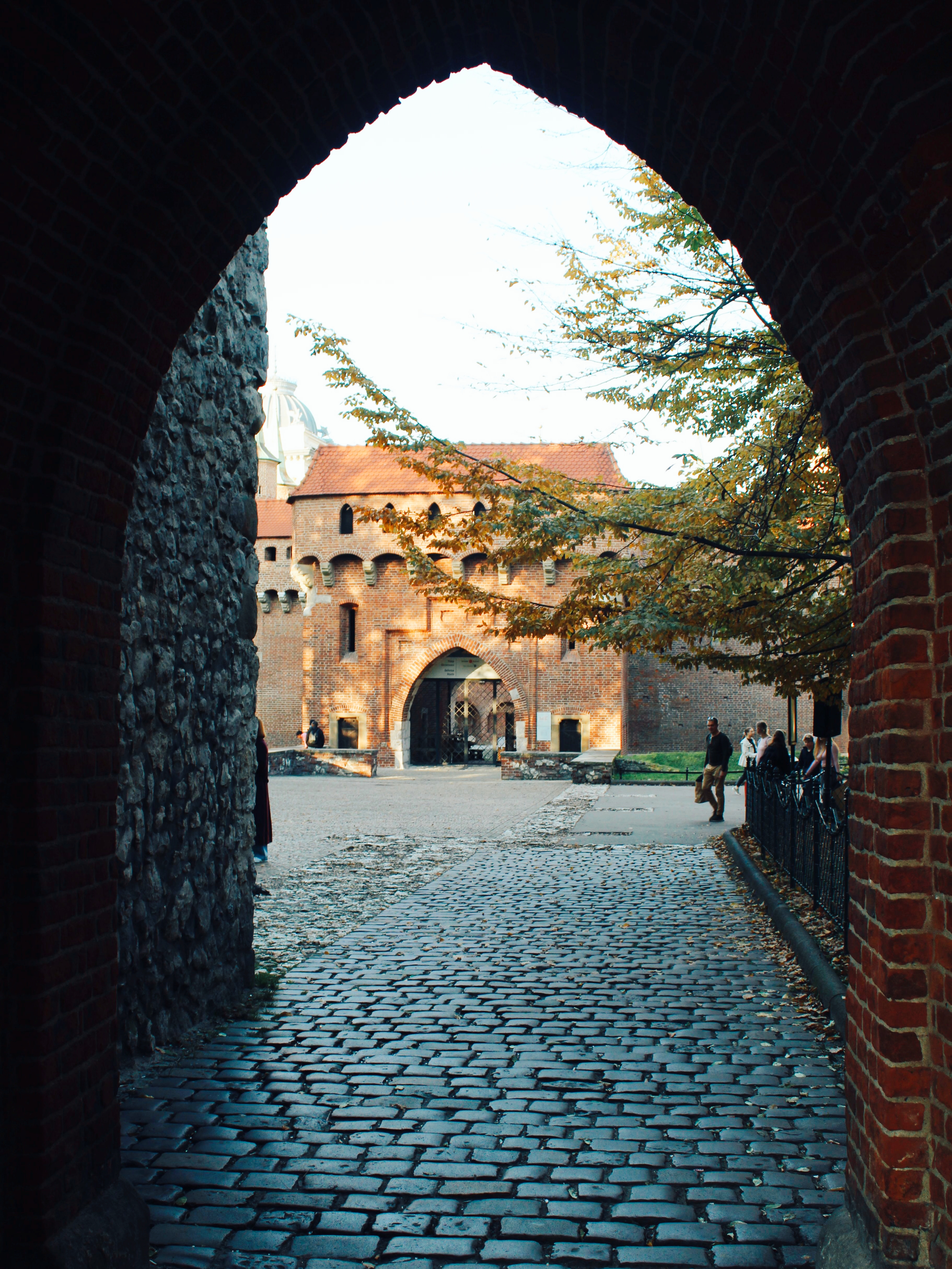
Barbican is a part of medieval fortifications which served as the main entrance to the city. Nowadays, it’s one of the very few parts of the fortifications that endured the wheel of time. Although, even though we can still look at the Barbican today, we can no longer see its surroundings as they used to look like back in the days of old. In medieval times, Barbican was surrounded by a moat which ensured that any enemies would have a really hard time entering the historical Krakow.
However, this defence mechanism carried some drawbacks and the most important of them was the fact that within the moat, garbage and slops were slowly accumulating. It didn’t take too long for the entire surroundings of Krakow fortifications to become horribly smelly – which had another consequence and that was faster spreading of contagion among Krakow inhabitants.
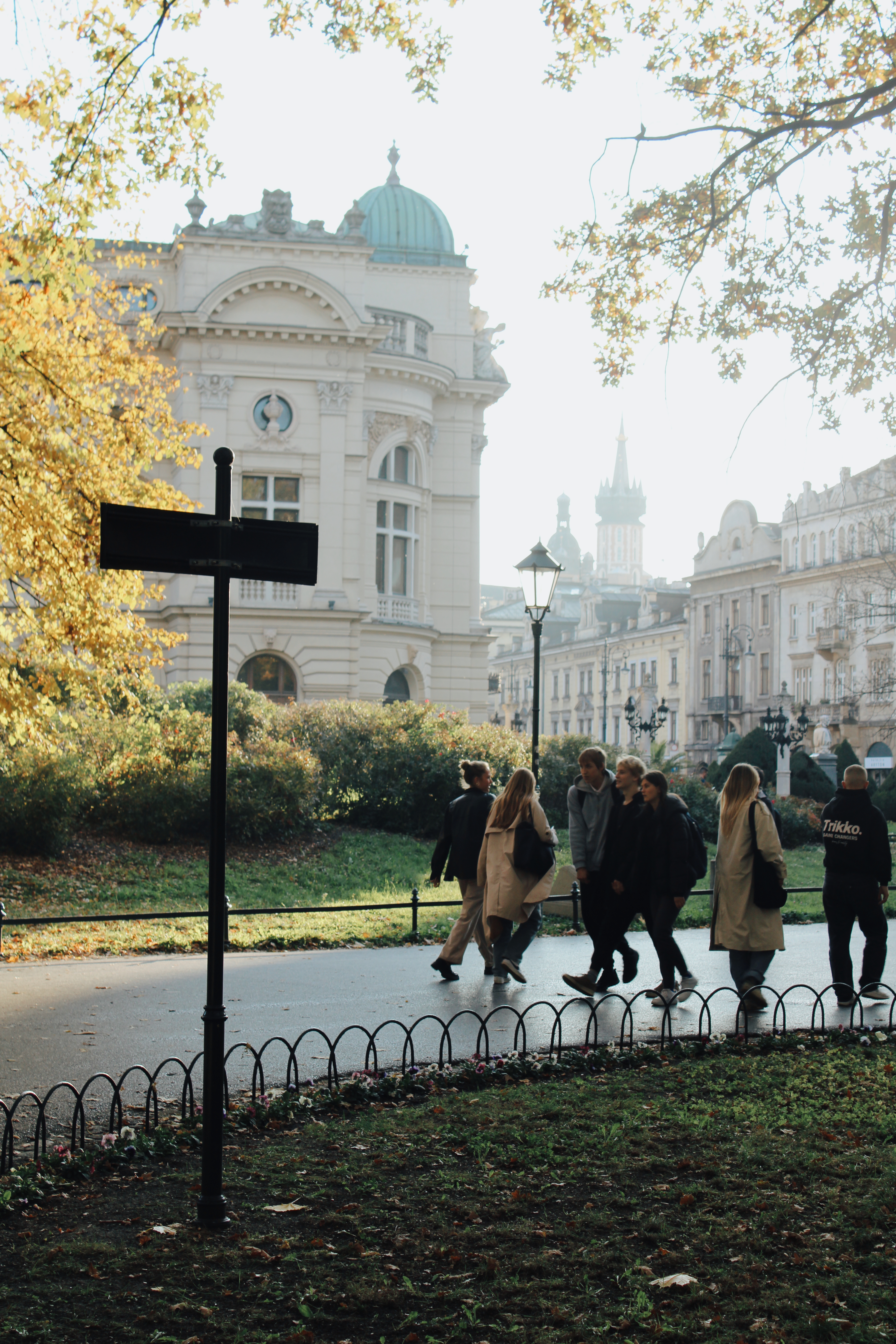
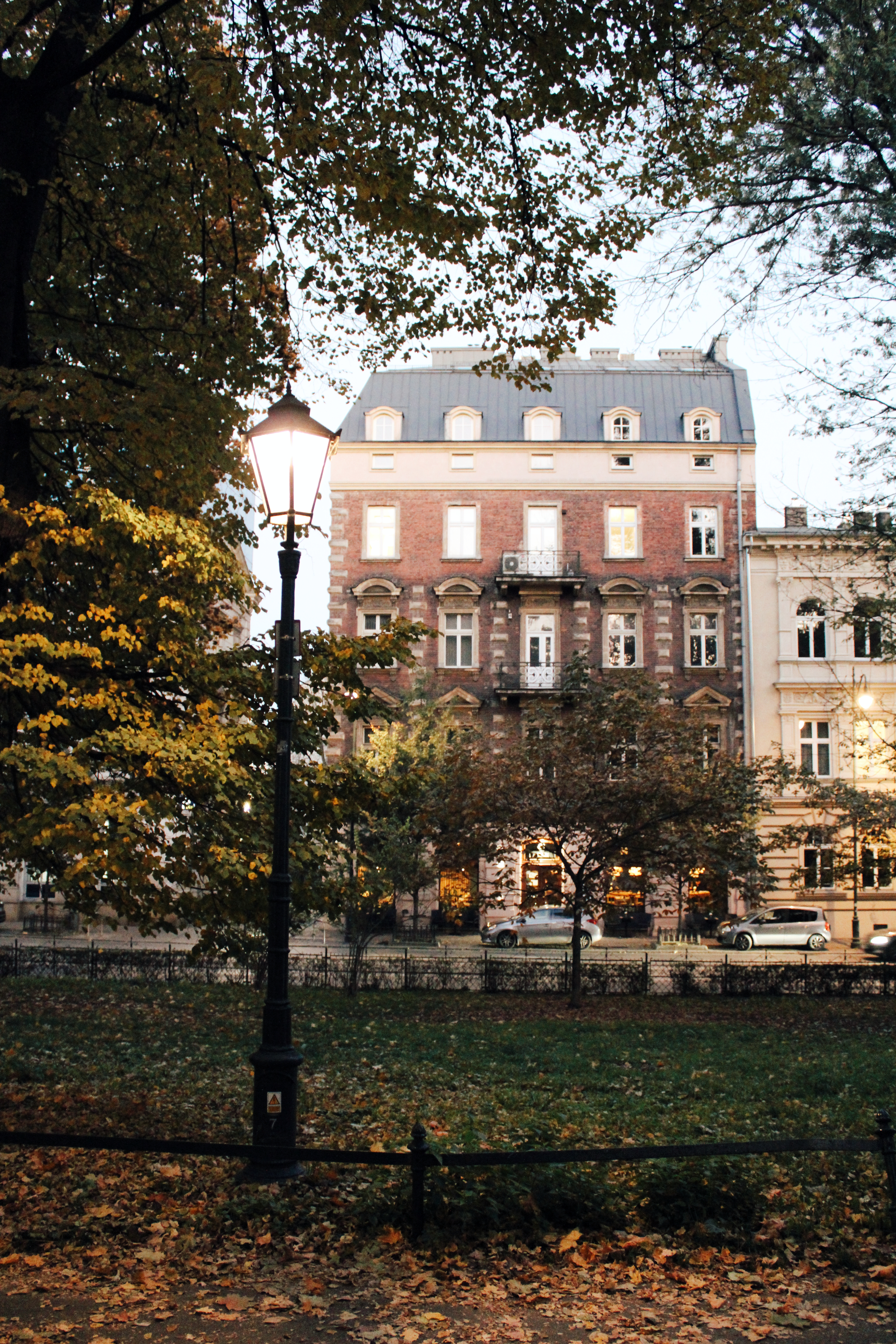
Therefore, in the 19th century (when Krakow city council was thinking about how to make the city a better place for living), it was proposed to fill in the moat and use this area to build a nice park that would be surrounding the very heart of Krakow. And this is the story of how we can now walk or ride the bike around the historical centre of Krakow in a calm and neat park called Planty. Yet, the old times have not been completely forgotten, as they are symbolized by the already mentioned medieval Barbican and St. Florian’s Gate.


St. Florian’s Gate and the story about the northern wind
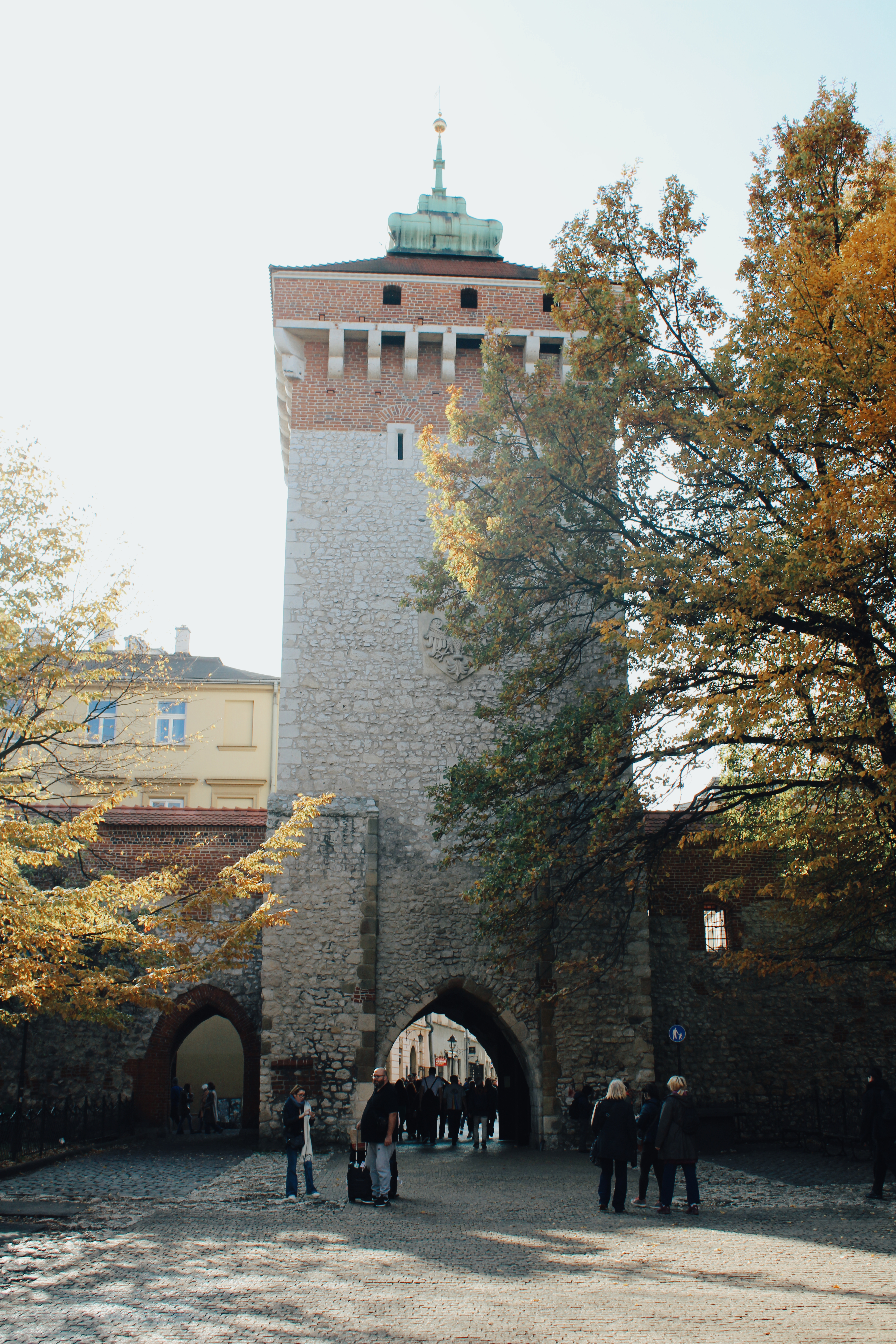
Another interesting fact is bound to the reason why the remains of Krakow fortifications were preserved only on northern side of the city centre. Though it may seem as a consequence of quite a random decision, there was actual reason for it – and that was the northern wind. The northern wind is cold and strong and the worst thing was that without any remains of fortifications, the northern wind would have a free route all the way to the main square of Krakow, with St. Mary’s Basilica, the most visited Krakow tabernacle.
And what happens if strong northern wind blew on the ladies on their way to the church? Their skirts may rise and people around could see the ladies’ ankles! So outrageous! No wonder they had to preserve the gate – though apart from considering that this was the primary reason for the preservation of fortifications specifically on northern side of the centre, it was quite a smart move.
The St. Florian’s Gate is also (for the reasons of the royal route) the starting point of the historical centre free walking tours. And I really want to recommend these tours because at least in Krakow, they helped me learn more about the history of the city than any other exposition I visited. Moreover, these tours carry an undeniable charm as the athmosphere is usually very friendly and the guides are usually very original and amusing. During this tour, we were told to imagine us being the new kings and queens of Poland that are walking in tracks of the ancient monarchs all the way to our future royal residence, Wawel. And this of course meant that each of us, guests, had a chance to feel like a royalty in the city of Krakow.
The Main Square (Rynek Głowny) and the story about a plan
When we walked through the St. Florian’s Gate, we found ourselves in a long street leading directly towards the main square (Rynek Glowny in Polish).
Just as shown on the 3D model of the old town located in proximity of St. Florian’s Gate, the entire northern part of the city centre is divided by such long and straight boulevards that together form a grid-like structure. It must be no big surprise that this plan of the city originates from medieval times (13th century, to be specific) when the Polish monarch ordered re-construction plan of the city centre from none other than German architects.
Yet, the southern parts of the city centre remain unevenly ordered – these streets and buildings can be exactly due to their uneven distribution recognized as the older parts of the centre. You will find these places if you follow the long straight boulevard all the way to the immense main square of Krakow. Just one small tip – take your time before you leave this place, as there is always so much to discover.

Cloth Hall (Sukiennice) and the story about Polish gastronomical highlight
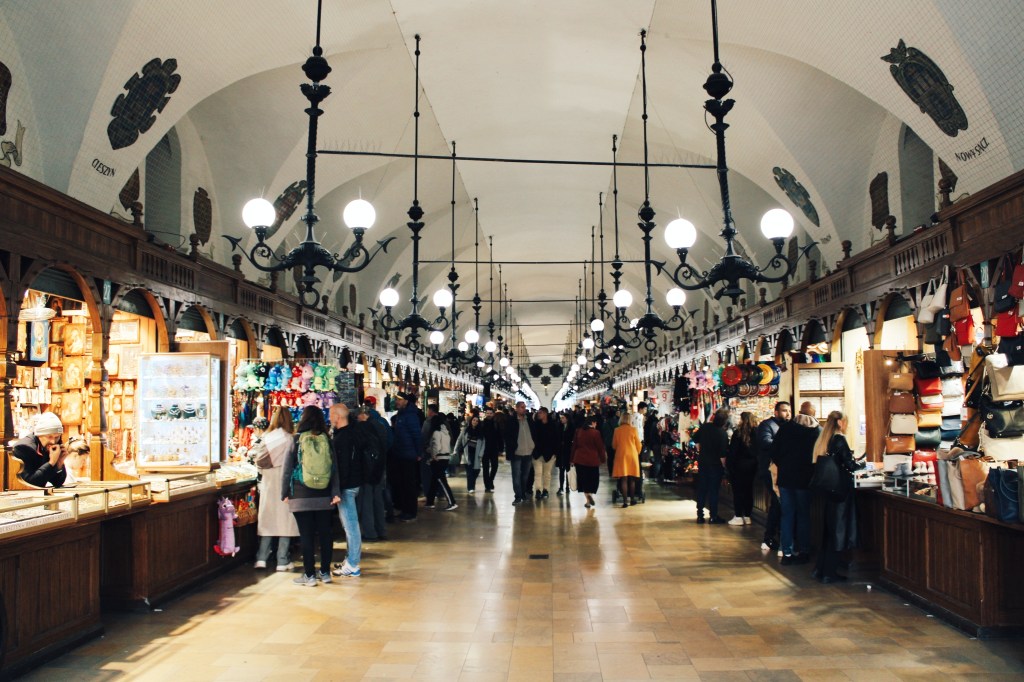
Rynek Głowny is among other things famous for regular hosting of the crafts market where you can find anything from handmade caps and scarves to the blacksmith’s and armor. An important part of these markets is taking place in a building called Cloth Hall (or Sukiennice in Polish), which you cannot miss as it is in the very centre of the main square. These are really the classic markets with anything and everything to be found in the small windowshops on both sides of the long hall. So if you even feel adventurous, you can also try and negotiate about the prices of the goods of your choice with the sellers – then you’ll really feel the authentic atmosphere of these markets.
Apart from souvenirs and craft goods, Krakowian markets always offer good food, mostly the traditional Polish pierogi. Though remember that pierogi at the main square can be sometimes a bit too costly, so in case you’re travelling on a budget, you can also find a good (and cheaper) restaurant serving pierogi a bit further away from the city centre (for that, feel free to check our list with preferred places where to eat in Krakow).
Talking about markets, it is important to mention that Krakow has one of the most beautiful Christmas markets in central Europe (which – at least a few years ago – were believed not to be as crowded as the Christmas markets of Vienna).
Church of St. Adalbert and the story about rising city
But let’s get back to our stories of Krakow. I’ve already mentioned there is a younger part of the centre with grid-like structure and older, quite disordered part of the centre with a web-like structure. When you’re at the main square, you can see both of these parts getting intertwinned. The best view is from the Church of St. Adalbert which used to be the main Krakowian church before the opening of St. Mary’s Basilica.
Another quite interesting thing that you can notice on the Church of St. Adalbert is that its entrance gate is now on the level of cellars. It might be quite obvious now, but the depth of where the entrance gate to the church is was the actual height of the main square hundreds of years ago.
How did it end up more than 3 metres higher than it used to be in the past? The short and accurate answer to this question is trash. Since the tradition of markets on the main square is also hundreds of years old, this lively square accumulated trash just like the moat around the city centre. The only difference with the trash on the main square was that as it through the years mixed up with rain and mud, the contamination soon became irreversible.
Thus, the final decision of the city council was in this case: set a new ground layer above these 50 layers of trash and bury the trash underneath. Therefore, the now cellars in the buildings at the main square (now used as restaurants and pubs) have such nicely decorated interior – they were not always cellars.

Old City Hall and the story about new city hall
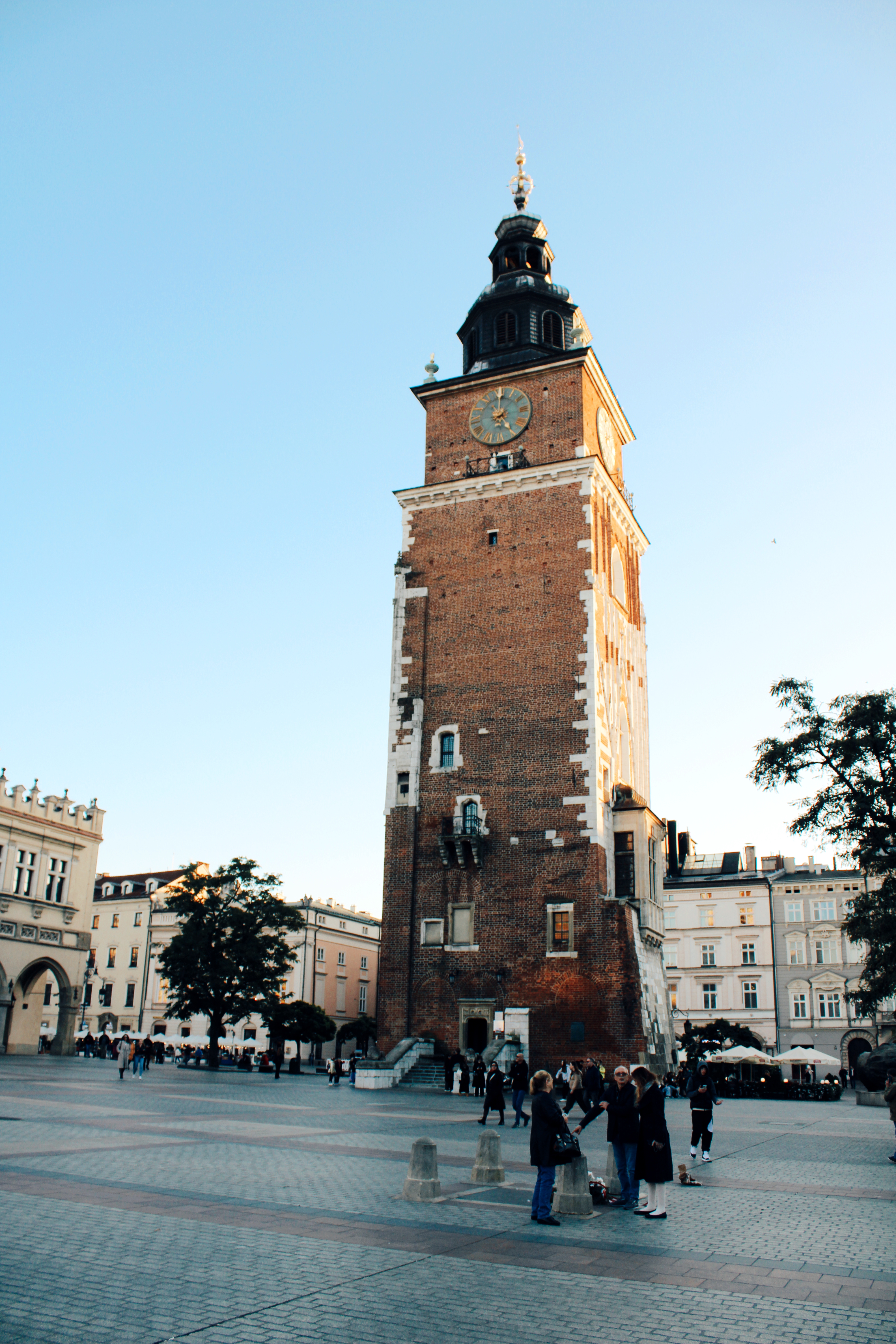
Apart from Sukiennice and the churches, the main square is also the location of the historical city hall of Krakow which is quite easily recognizable by the fact that in present days, it’s only a tower. Other parts of the (in the past) bigger building of the city hall have been subject to demolition.
Still, Krakow never actually built a modern city hall so this is the only Krakow city hall we can admire.
Stanisław Wyspiański Memorial and the story about his weddings
Of course, the main square has a separate space dedicated to the memory of famous Polish citizens and thus, right there in the main square we can commemorate several important historical persons, specifically writers.
The first of them, Stanisław Wyspiański has a memorial plaque right next to the St. Mary’s Basilica. He is till this day very famous writer of tales from Wesele which means weddings in Polish.
However, his fame was not always for positive reasons as it is known he used to write mainly the stories from weddings he attended himself. Also, it is known that in his very initial works he did not even bother to change the names of the main characters, like bride, groom or the wedding guests – he just went along with their real names. Therefore, his works (which are now of course seen as masterpieces) were in his own times considered more like an encyclopedia of gossips about his fellow Krakowians.
Adam Mickiewicz Monument and the story about jumping students

Another famous writer who has his own memorial at the main square is Adam Mickiewicz. He has a big statue right next to the Church of St. Adalbert for he is believed to be the greatest poet of Poland, though due to the vast outreach of his works, he is being a subject of conflicts between Poland, Lithuania and Belarus.
Regarding his statue, there is one quite funky saying trading among the students. It is believed that before an exam, jumping around the statue of Adam Mickiewicz on one foot will secure you a good grade for tomorrow. What’s even more funky, is that the better grade you want, the more rounds of jumping around Adam Mickiewicz statue you need. So in case you sometimes see youngsters jumping around this statue on the main square, this saying will probably be the reason of their foolishness.
St. Mary’s Basilica and the story about towers and brothers
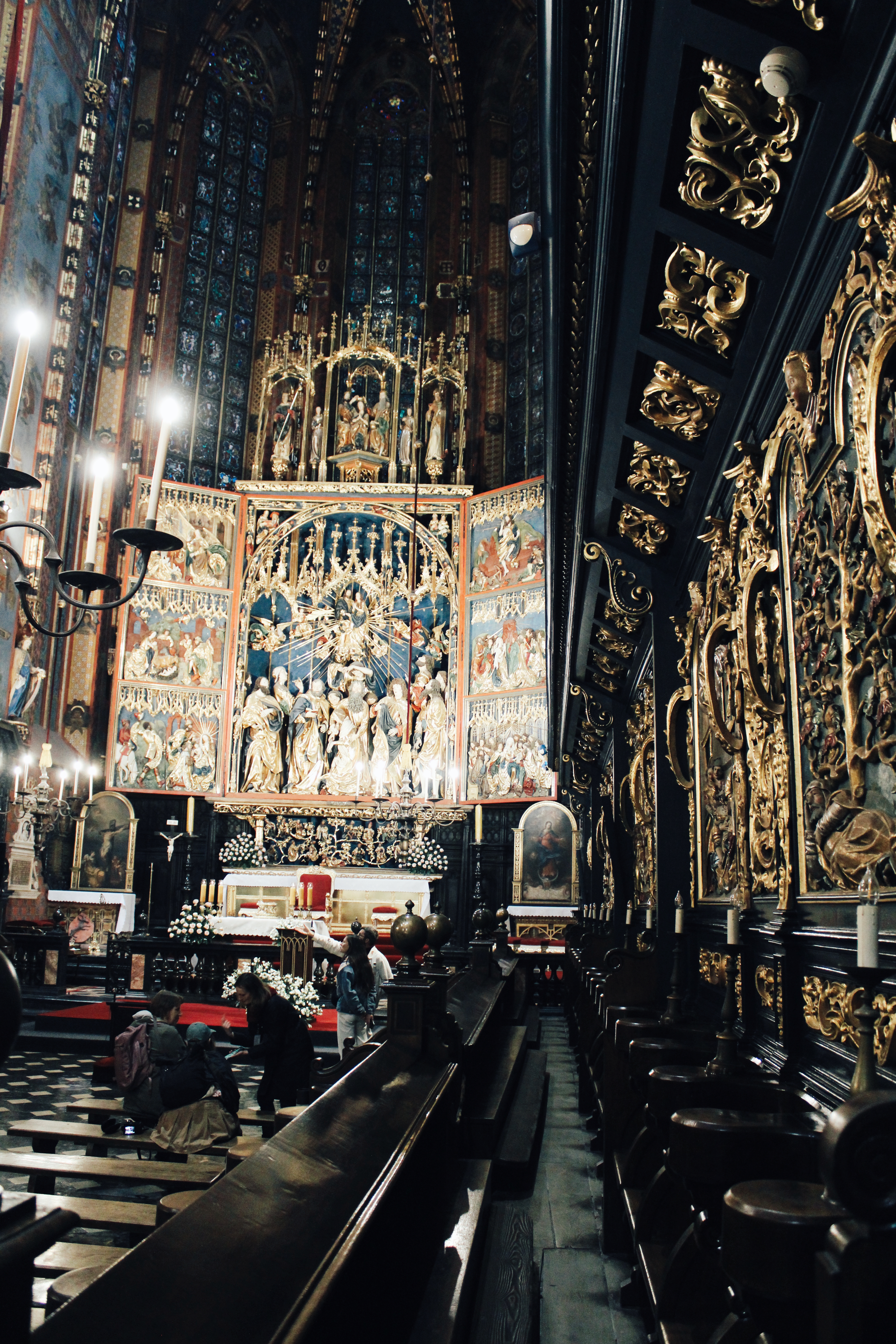
Before leaving the main square, we must not miss out on its absolute dominant (and one of the dominants in entire Krakow), St. Mary’s Basilica. The construction of this architectural jewel started in early 13th century, though due to subsequent devastating attacks of Tatars and the necessary re-construction, the church was finished only hundreds of years later.
Now it offers a real feast for the eye of every visitor due to its Romanesque/Gothic heterogeneity handled with not small piece of elegance.


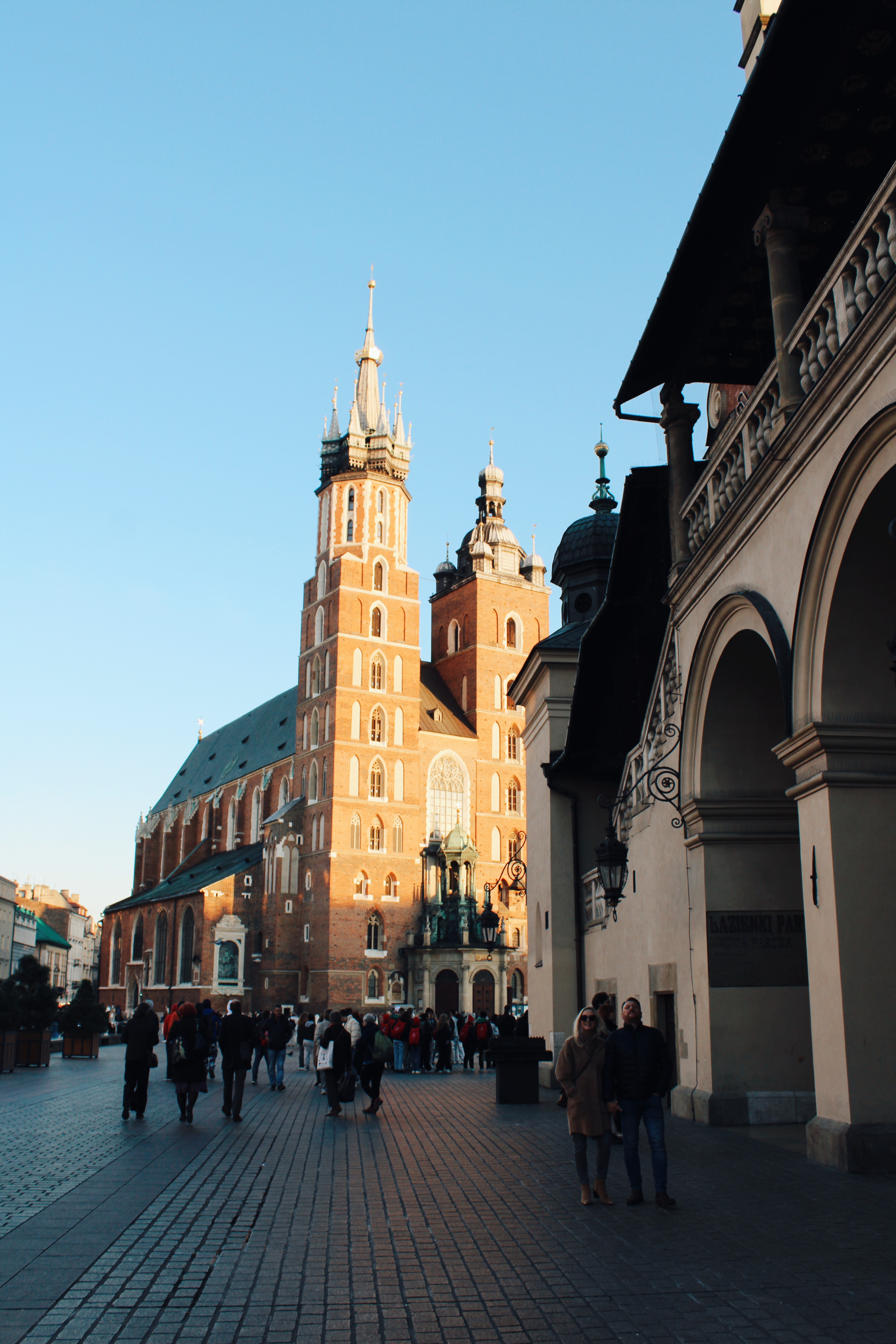
Of course, dominating are the two towers of different height which are for a long time already a strong reason to ask question: Why are they different? There is a legend that says two brothers were once asked to build two equal towers of St. Mary’s Basilica. Both accepted this offer and each of them was assigned one of the towers.
However, as brothers are usually quite competitive, so did these brothers create a small competition in this matter. The point was – the one who builds his tower first, wins. In the end, the younger brother succeeded in being the first one to finish the southern tower. Yet, the older brother was of fierce and jealous character and thus, to his satisfaction, he built the northern tower a few metres higher.
This really struck the younger brother who on the day of consecration came up to his brother and pierced his heart with a knife. Though immediately when he realized his terrible deed, the younger brother pierced his heart with the same knife and then, he dropped the knife from the top of the tower of St. Mary’s Basilica. This is the end of story of two brothers about whom we have no other memory than the two beautiful and unique towers.
Although, one more memory can be found in the Cloth Hall (Sukiennice), as the knife that the younger brother dropped from the top of the tower is displayed there, hanging on a piece of rope in proximity of the entrance from the northern side.
Despite this story being totally epic, I think it is also important to mention that the truth about the towers of St. Mary’s Basilica might be a bit more pragmatic in comparison to the tragic story of the two brothers.
So, here’s just another story (and you may choose which one you want to believe in the end): The towers of St. Mary’s Basilica were never meant to be the same height due to distinct functions they were assigned already before re-construction of the church.
Whereas the southern (smaller) tower was meant to be used as a belfry, the northern (higher) tower was planned as a watchtower and thus, Krakowians were trying to make sure it will be the highest point near and far so that they could reliably see the potential attacks as soon as possible.
Bugle Call and the story of brave watchman
This brings me to another legend connected to the northern tower and it is the story of the famous bugle call. The bugle call is a short melody that used to be played for centuries everyday at dawn and during sunset, by a watchman seated at the top of the northern tower of St. Mary’s Basilica.
It was also a tune that was meant to warn the citizens of Krakow about upcoming attacks of the enemies. Nowadays, it is one of the most iconic Krakowian traditions and the tune is being played every hour (even during the night) 4-times – once in each of the cardinal directions.
The tune is now being played by the members of the firefighters who aside playing the melody also keep their watchful eye on the surroundings in case of any fire. However, there is one thing about the otherwise very noble melody which might feel quite weird. It is the last tune of the melody which is ended quite abruptly.
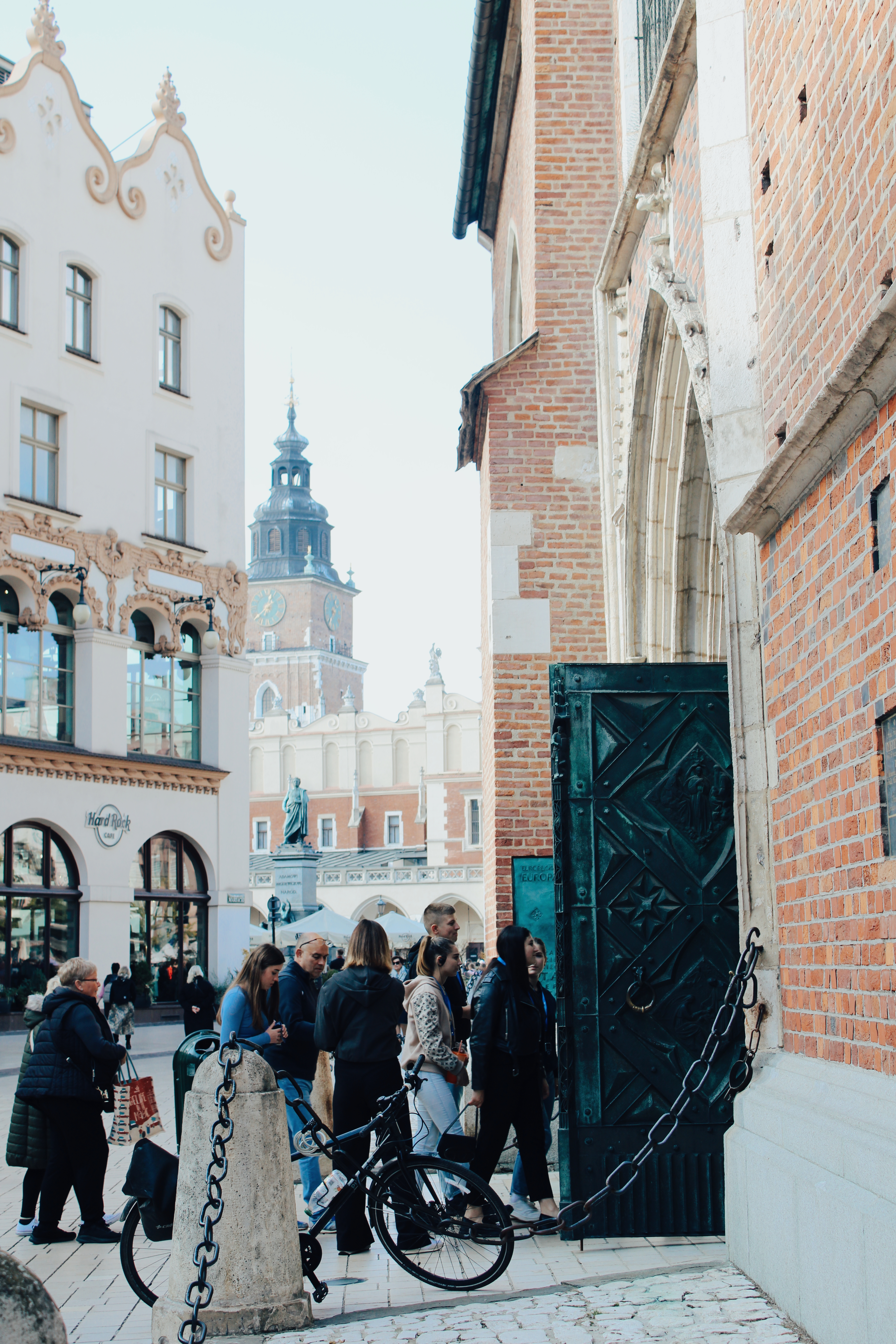
The reason for that is the unfortunate event from 1241 when the watchman at the tower suddenly noticed a Tatar army riding towards the city gates.
To warn the citizens of Krakow, the watchman opened the window on the tower and started playing the iconic melody. Luckily, he managed to wake people up soon enough so that they made it in time to the gates and the city could withstand the unexpected attack.
However, the brave watchman himself did not survive the attack since one of the bowmen managed to hit the watchman right to his neck with an arrow as he was playing the melody.
To commemorate the brave watchman, people of Krakow decided to end the melody at the very moment when it was cut by death of the brave guard at the St. Mary’s Basilica in 1241.
Jagellonian University and the story of the first queen of Poland
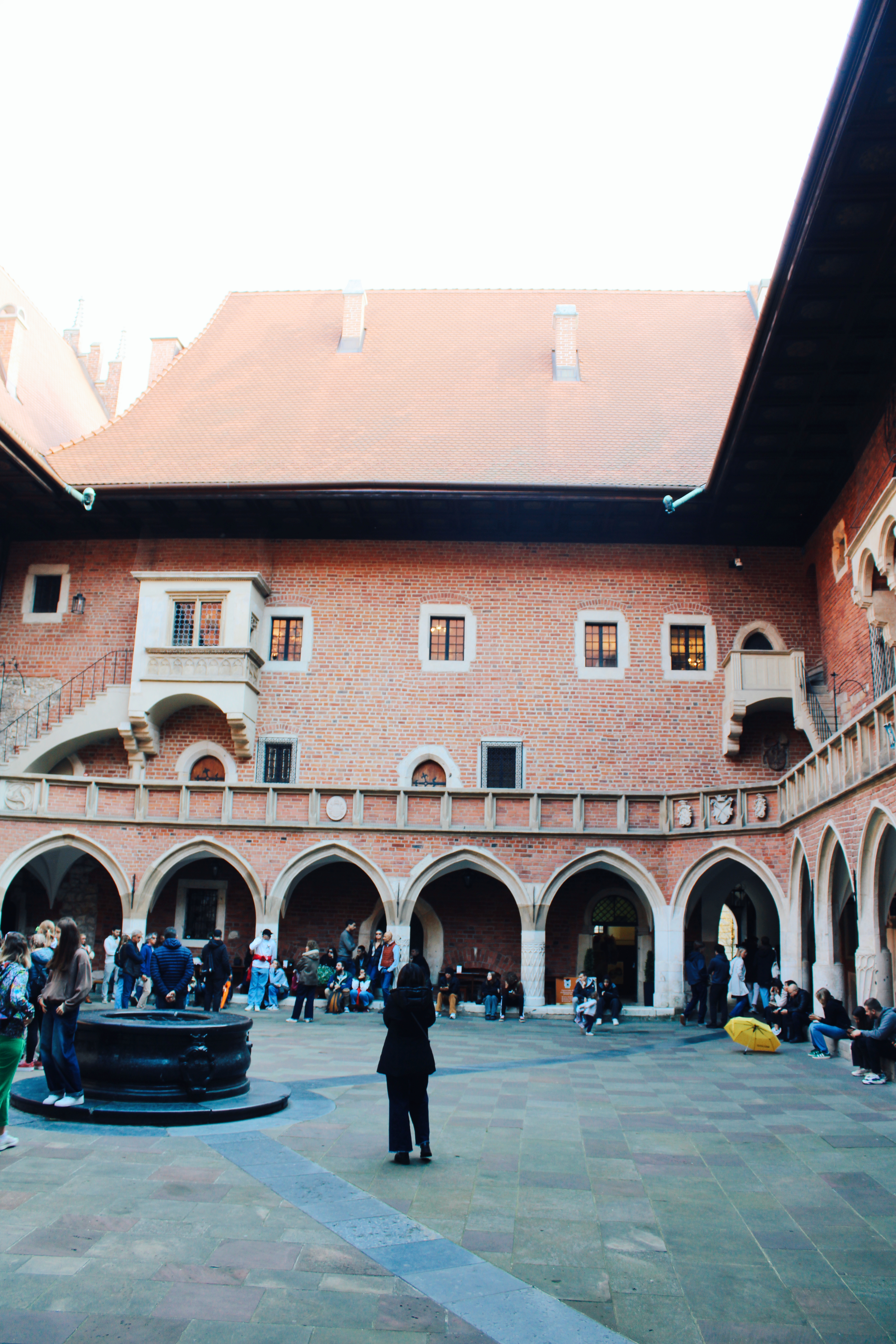
Taking a small detour from our royal route, in the proximity of the main square, there is another historical place worth seeing. It is known as Collegium Maius or as the historical part of Jagellonian University, one of the oldest universities in Europe and the oldest university of Poland.
As you can already expect from the name of the university, it is strongly connected to the Jagiello dynasty, specifically to Kazimierz I. Velky who is believed to be one of the greatest kings in Polish history.
He was the one who established the university all the way back in 1364. Unfortunately, with soon death of Kazimierz I. Velky, the university stopped existing after 1370. Meanwhile, the throne passed over to the nephew, Louis I. of Hungary and Poland. At the end of his life, Poland was again facing a huge problem – the Polish king didn’t have any sons. However, Louis I. managed to negotiate that one of his daughters would take over the reign over Poland after his death.
This way, Poland gained its first queen who is now believed to be one of the best rulers throughout the history. Queen Jadwiga of Poland earned this status by not only great management of the kingdom, but also by her focus on improving the options for high-quality education.
In the first years of her reign, she also re-established the Jagellonian University which is a functioning institution until this day. And at the Collegium Maius, you can have a look at one of the very first buildings that belonged to it. It’s magical as you can see the historical courtyard almost frozen in time.


Zwierzyniecka Street and the story of Lajkonik
Another (this time quite funky) story brings us to the Zwierzyniecka Street which is connected to the historical legend of Lajkonik. The legend dates to the 13th century, to one of the (at that time) quite frequented Tatar raids.
One such Tatar was planned in a swift manner, as the riders wanted to camp at the side of Vistula River and use the element of surprise as they would rise against the unsuspecting Krakowians from the morning mists.
However, when arriving to the borders of the city at dusk, the group of Tatars was noticed by local raftsmen who came in night and eliminated all intruders. The next morning, the group of raftsmen decided to make a prank on the citizens of Krakow so they dressed into the Tatars’ clothes and rode the horses of the riders all the way to the main square.
Of course, the raftsmen managed to scare the Krakowians to death at first but after the Krakowians realised it had all been just a prank, they laughed and expressed their gratefulness to the group of raftsmen who saved them from a true Tatar raid.
So on that very day, Krakow city council decided to make a tradition that every year, such ‘group of Tatars’ would ride from the nearby village of Zwierzyniec all the way to the main square to commemorate the saviours and the prank. And thus, Lajkonik – i. e. Tatar invader riding a hobby-horse – haunts the city of Krakow each year (usually on the first Thursday after Corpus Christi), spreading good vibes along with his colorful parade. Due to this long tradition, it must be no big surprise that legendary Lajkonik is now considered one of the main symbols of Krakow.
St. Andrew’s Church and the story about the last shelter
Getting back on track of the famous royal route of Krakow, we will move on to the Grodzka Street. You might as well sense we are getting closer to the castle since Grodzka in Polish means literally the ‘castle street‘.
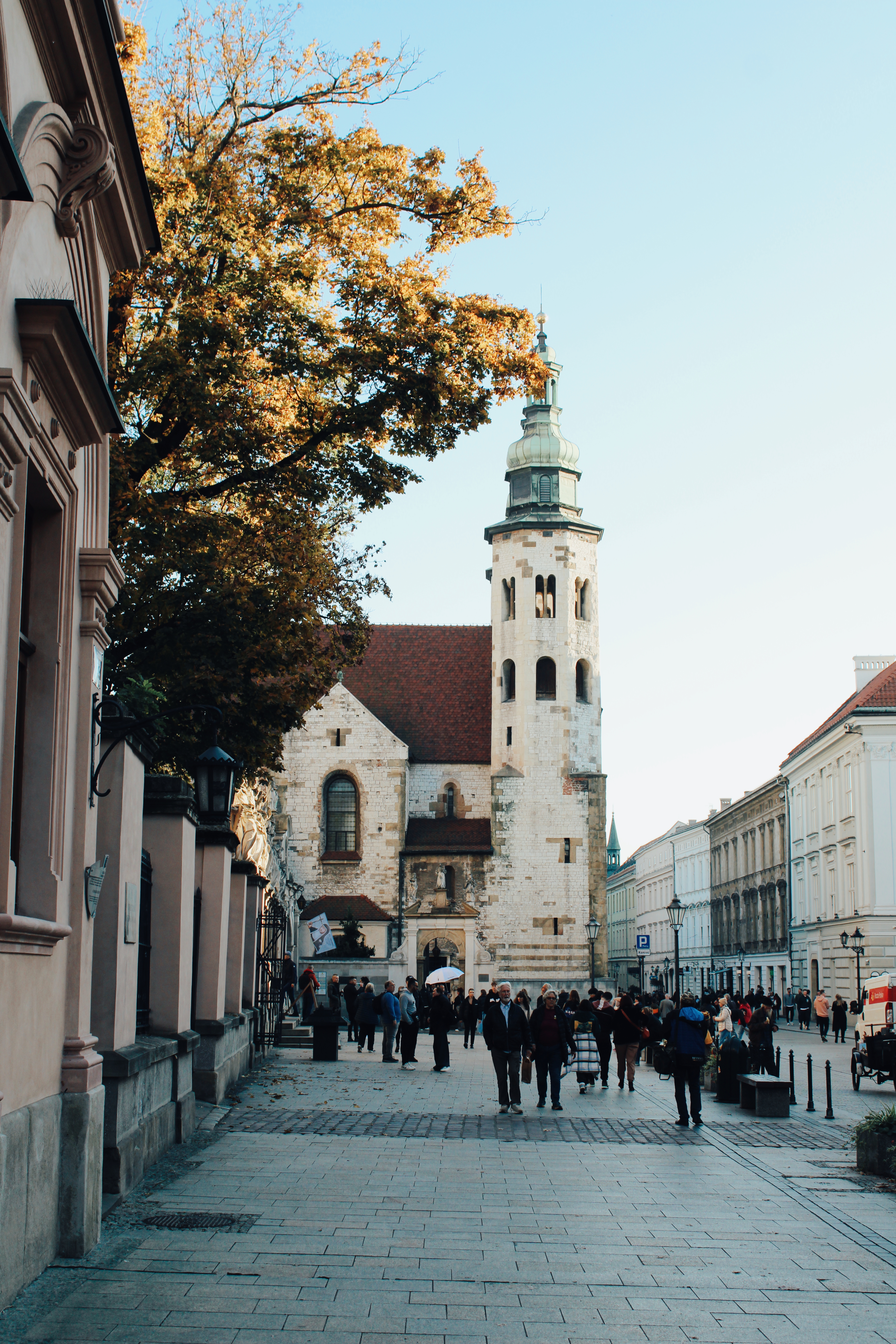
In this street, you will not only be able to find remarkable restaurants (including the Polish version of Leaky Cauldron from Harry Potter), if you walk this street long enough, you will end up right next to one of the oldest churches in Krakow (if not the very oldest), the St. Andrew’s Church.
What is particularly interesting about the St. Andrew’s Church, it’s the fact that this Romanesque tabernacle from the 11th century was not always just a place for prayers but also an important shelter in case of emergency.
Specifically during the Tatar invasions of the city in the 13th century, this church was one of few buildings in the city that withstood fierce attacks of the invading army (probably due to its thick walls penetrable only through loopholes that the inhabitants of the church used for their defence).
Due to the endurance of the building, the church was also given a nickname ‘Lower Castle‘ which distinguished it from the ‘Upper‘ Royal Castle on Wawel hill. And this is exactly where we are heading now…
Wawel Dragon and the story about a ruse
Welcome to Wawel Castle, the residence of Polish kings and queens! Before we walk atop the hill right to the castle courtyard, we shouldn’t though miss out on a very remarkable inhabitant of the castle (the one about whom there might be even more tales and songs written than about any of the Wawel kings or queens). I guess you already know to which place and which story I am now leading you. Exactly!
In a den under the castle hill, there is the residence of the famous Krakowian dragon. According to the old tales, this dragon used to terrorise the Krakowian folk for long years during the medieval times and even though many people tried to slay the dragon, none of them was able to succeed.
Until one day there came a clever shoemaker who proposed a ruse: he then got a dead ram, filled its inside with sulphur and during the night, he left the bait in front of the dragon’s den.
Next morning, the dragon came out of his den and saw an easy prey. He almost immediately ate the whole ram and as he wanted to go back and unwind, he realised that his stomach and throat is burning him so much so he needs to drink.
So he then flew down to the Vistula River and quenched his thirst by drinking a lot of water. However, as the water cannot put out the fire produced by sulphur, the dragon could not be saved. In a few moments, the stomach of the dragon was so full of the gases produced by burning sulphur that the dragon exploded.
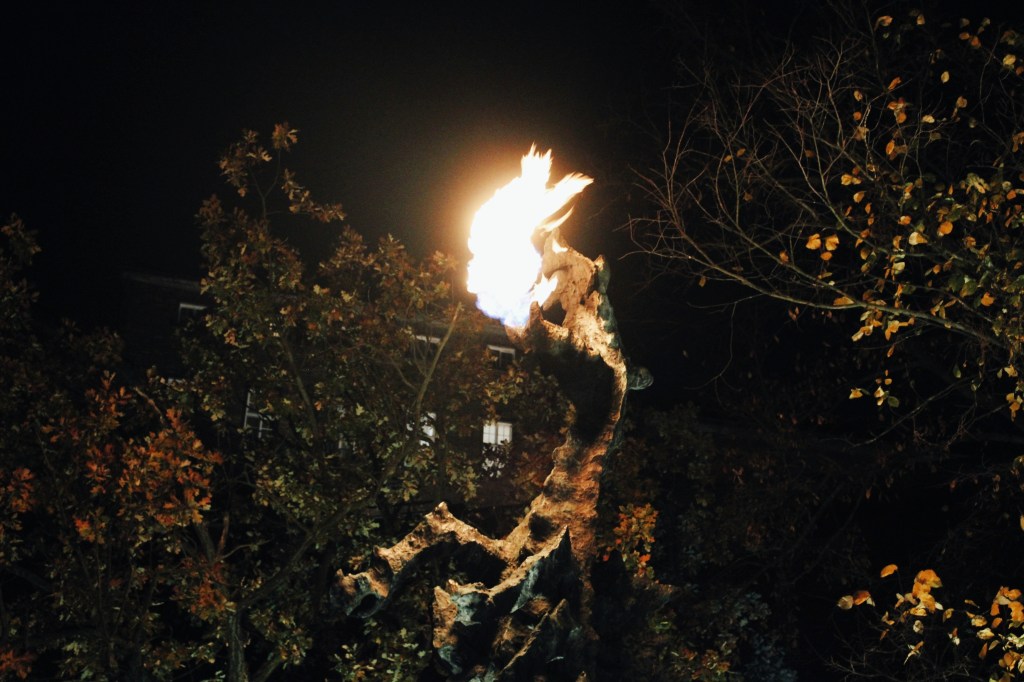
And finally, the Krakowian folk was able to live in peace and safety. Yet, to commemorate the existence of the mysterious dragon under the Wawel hill, Krakowians displayed a statue of the dragon in the park underneath the castle. And what a dragon it is! It even breaths fire every now and then (in 3-minute intervals, to be specific). So if you want to catch a glimpse of the atmosphere of dragon-terrorised Krakow, make sure you will not miss out on this great show.
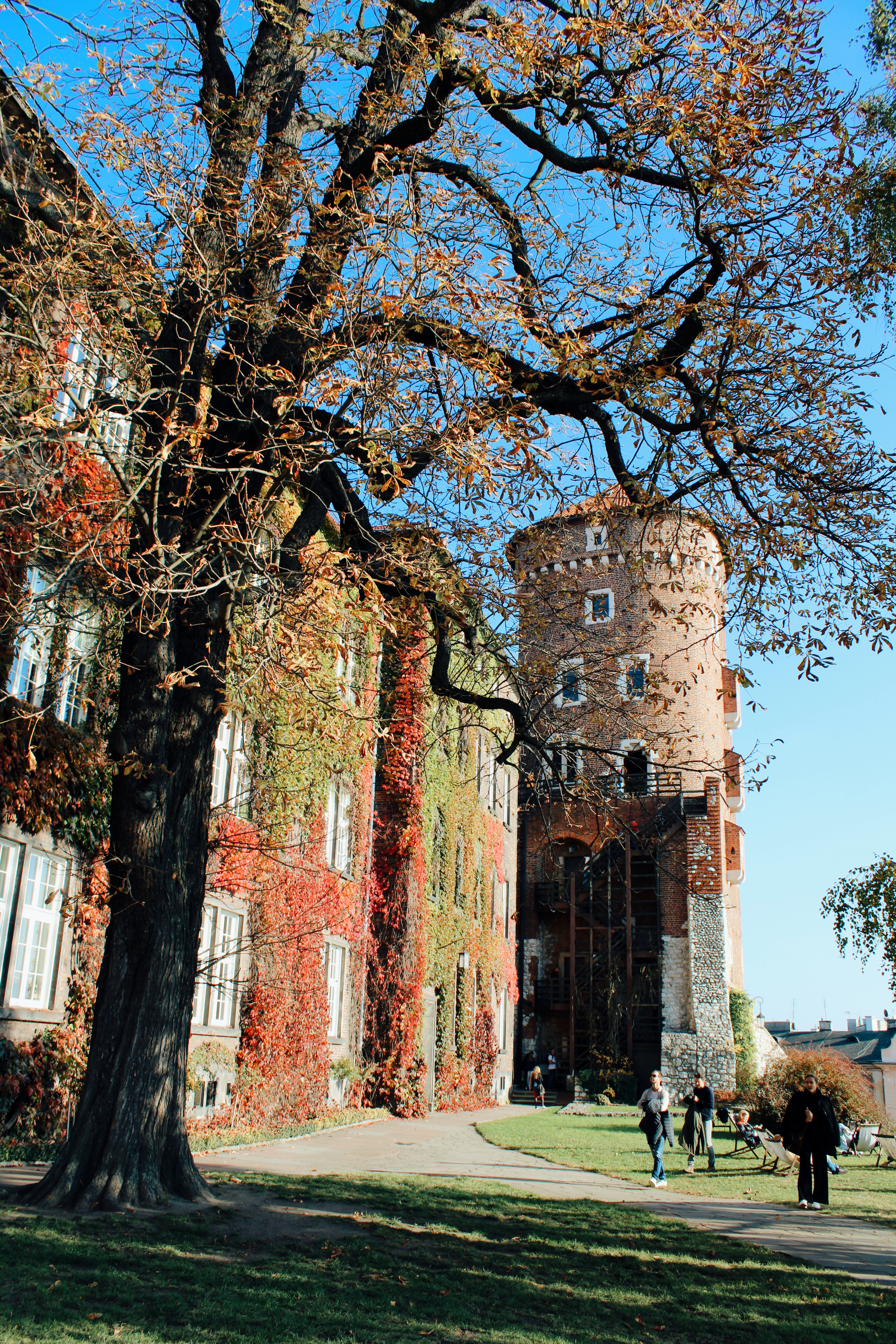
Wawel Castle and the story of why Krakow lost status of capital city
Though it’s also important to say that the mysterious Wawel dragon is far from only interesting thing you can see in the surroundings of Wawel. If you walk up the hill, you will not only have a chance to see the stunning courtyard of the castle, but also have wonderful views of the city centre and neighbouring Kazimierz.
Wawel Castle itself is really interesting by the presence of Italian motifs on the facade which is due to the marriage of Sigismund I. who wanted to bring Italy to his Italian wife that moved to Poland to be with him.
Unfortunately, not all of these motifs preserved till now, since in 1595, the north-east wing of the Wawel Castle burned down to a ruin. It was caused by a quite unpopular monarch in history of Poland, Sigismund III. Vasa who was a great fan of alchemy so he used the chambers in the north-east wing for his experiments on turning lead into gold etc.
Moreover, during the re-construction of the royal castle, King Sigismund III. Vasa said to himself he would rather wait for the castle to get renovated from a more comfortable residence and thus, he moved to nearby city of Warsaw. And despite his promises, he actually never returned to Krakow again. And this is the story of how Krakow lost the status of capital city in favor of Warsaw.


Wawel Cathedral and the story about its heterogeneity
Still, king Sigismund III. Vasa, alike all other Polish monarchs, is buried in the royal tombs in the Wawel Cathedral. This tabernacle can be easily recognized by the vast heterogeneity of architectural styles which create the truly remarkable view on the cathedral in its entirety.
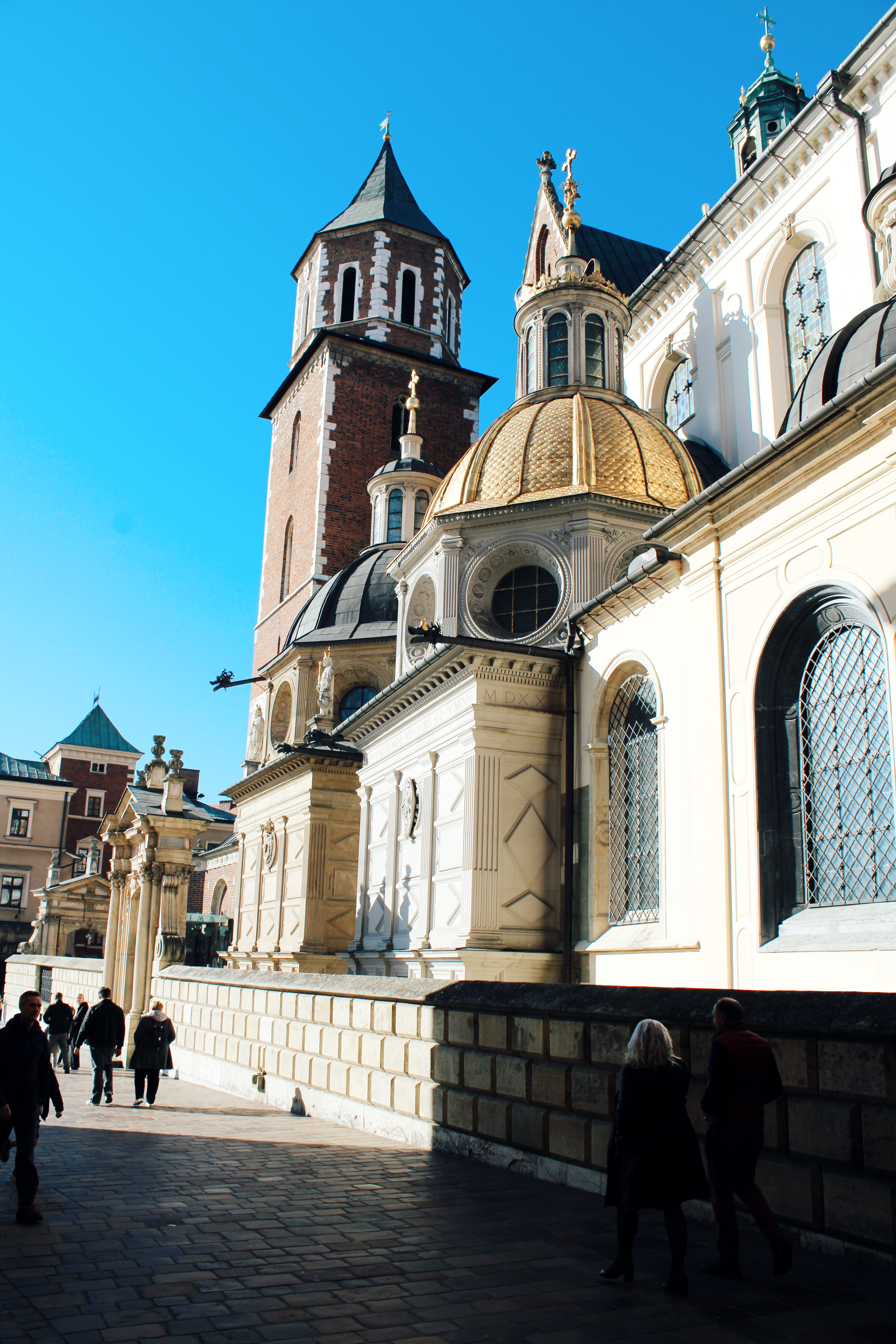
The differences between distinct parts of the cathedral are of course the result of different preferences of royal dynasties through the ages, as well as the reflection of their financial situation.
However, the ancient monarchs are not the only persons who rest in the cathedral. As I’ve already mentioned, you can find tombs of significant Polish persons (e. g. Adam Mickiewicz, Fryderyk Chopin or Lech Kaczyński and his wife) underneath the cathedral.
Even more interesting is the fact that whereas in the main part of the cathedral, it is strictly forbidden to take pictures, it is actually allowed to take pictures of the tombs underneath the cathedral.
Sigismund Bell and the story about its magical power
Another part of the cathedral with no restriction on taking the pictures is the tower with the famous Sigismund Bell. This bell is named after the very much beloved king Sigismund I. and it is the heaviest bell out of total 5 bells located in the Wawel Cathedral.
It might come as no big surprise that the bell weighs 13 tons and that it requires in total 12 people to make it ring (which happens only during the national hollidays).
It is also considered as one of the national symbols of Poland and last but not least, this bell is considered magical as it can make people’s wishes come true.
All you need to do for that, is to place your left hand on the heart of the bell and as you touch the heart of the bell, think of your wish. I tried it several times and you can guess if my dreams came true now that I recommend this for you to try out.
Also, do not forget to look out of the window once you’ve climbed up the narrow staircase all the way to the Sigismund Bell – the view is indeed magnificent.

So what to conclude about the Wawel castle? It is a true dominant of Krakow and it definitely deserves a visit (for which I would recommend to reserve even 2-3 hours).
Unfortunately, even though there are many tours available in the area of the castle (either individual tours or guided tours with an audioguide), I must say we did not really learn anything about the castle or the Polish history during the tours provided at the castle. Yet, the castle tour no. I offers a very nice overview of tapestries, paintings and ceramics from various ages.
But just a friendly note to wrap up my stories about the castle: If you are interested in the actual history of the castle, the best way to learn about it is to take a free walking tour around Krakow old town. It will provide you a nice summary of historical facts (and sometimes also some legends) of most of the places in the centre and it ends at the castle hill, where you can then directly continue with some other program (e. g. tour of the cathedral).

I hope that the previous paragraphs convinced you that Krakow historical centre is a stunning place connected to large amount of interesting stories that creates an absolutely unique athmosphere. To me, it was fascinating just to observe how history and modernity gets intertwinned in so many places in Krakow which is exactly the thing that I consider as Krakow’s biggest advantage. So whenever you ask me whether I would recommend you to go and see all the mentioned places by your own eyes, I would definitely say yes.
Love,
Antonia
PS: I’m also attaching a list of our top restaurants, cafés and bars that we managed to try out while we were in Krakow, both in the historical centre and the more hip parts, Kazimierz and Podgórze, that we will talk about in the post Kraków part II:
- Pierogarnia Krakowiacy – for traditional Polish pierogi
- Nolio Pop – for Italian pasta and delicious pizza
- Akita Ramen
- Ramen People
- Tacoteka Krakow – for Mexican cuisine
- Khachapuri – for Georgian cuisine
- NAPNAPCAFÉ – for brunches (near city centre)
- Ranny Ptaszek – for brunches (in Kazimierz)
- Somnium Cafe Bar – great coffee
- The Trust – great cocktails
- Zapiekanki Krolewskie – best fast-food in Krakow
 Love Letters to the World