

Others call it the meeting point of western and eastern cultures. The city where all the principles and ideologies harmonize together, no matter how different they are. To be honest, I had not known much about Sarajevo before I arrived there but that’s probably for the best, as my lack of knowledge about the historical context of this beautiful city only intensified the surprise of its unique character.
Prologue
& the story of how we nearly didn’t arrive to Sarajevo at all
The city seems quite small at first sight – but its location with old centre in the valley and lovely small suburbs in the mountains makes it look bigger. What I can (and must) recommend is to walk up the hill and take a look at the city from up there. It will not only make you feel powerful (as the view is truly breathtaking) but on the way up you can also burn some calories.

I could also tell you the story of how I walked up one of the hills surrounding Sarajevo but there’s really not that much to talk about. I don’t have the stamina of a sportsman and yeah, that night I felt like I never had any stamina at all but still somehow (with a little help from my friends) I managed to accomplish this goal. And you know what everybody says – if you can’t go on, then go faster (maybe even by persuading your friends to turn your walk home into a funny race).
That time I was walking home from Baščaršija which is the Bosnian word for the old city centre lying at the riversides of Neretva. It is the very place where so many important things happened throughout history. Today, this place means a lot to all the Bosnians who are right to be very proud of the city they call their capital – but it is not only locals who enjoy its athmosphere. Through day and night are the little streets around Gazi Husref Beg’s mosque filled with tourists who come to see and absorb the energy of this magical place. Truly, the streets are so narrow and yet so full of life it makes you feel as if you were about to step out of the reality and walk through the world of Orient just as you know it from the fairytales your parents were reading to you when you were a child.
The little streets connect at the square created around Sebilj – or in other words the wooden fountain built in the mid 18th century which symbolizes an open gate to the heart of the city. The entire square might overwhelm you at first, just as it left me in awe when I first walked through. The concentration of people (and pigeons) here is usually very high but after all, you cannot feel the cultures intertwinning so intensely anywhere but here.
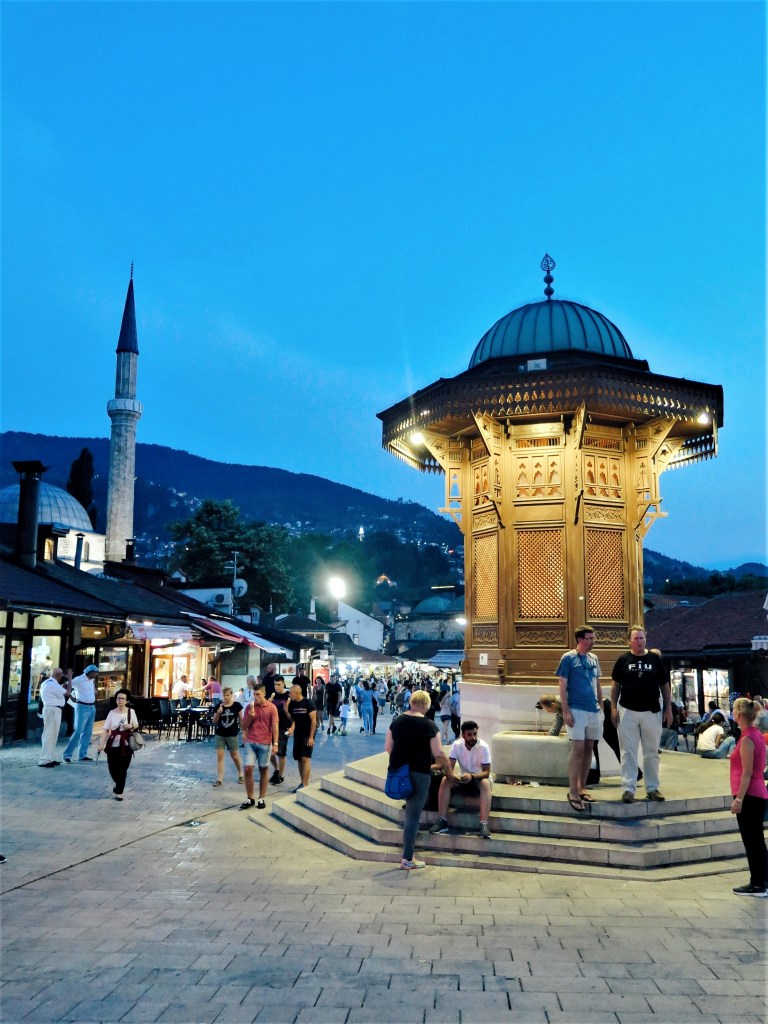
I remember this lovely symbiosis was the first element of Sarajevo’s athmosphere which made me feel incredibly comfortable that night. Completely mesmerized by the friendly environment and the style of streets in the old centre, I felt lucky to have got lost within this stone maze of Baščaršija. The setting sun was slowly moving on the summer sky as I was discovering more and more of Sarajevo. I even stopped to have a quick date – with Mr. Nikola Tesla whose statue can be found at the street.
Bosnians are really proud of the fact that Sarajevo is the only city in the world which has mosque and Catholic church located just 200 metres away from each other. This was very surprising for me when I first heard of it from one of the locals who told us some stories about Sarajevo. At that time, we were sitting at the terrace of our new accomodation, enjoying a glass of ice-cold water with a lovely lady, Senida, after our long and surprisingly adventurous journey from Zagreb. We told Senida all about how we travelled 2 hours more than we first expected, just because we got lost somewhere on the halfway and instead of following an a highway, we continued our journey through some Bosnian forest. In the end, we lost track of concrete road and went with our car through the roads between trees, not knowing where we’ll end up (and you know it was truly a high adrenaline experience, since Bosnian forests are still full of mines left from the times of Bosnian war). In the end, we found our way out of the woods and arrived to some small village with farmhouse and huge meadow with cows. Till this day, I remember myself being completely freaked out while one of my friends was just walking around the car and breathing fresh air. For a moment, he stopped, raised his hands up to the sky and with a sigh of joy, he said: „Mmm, Bosnia!“
Since I’ve been able to tell this story to the lady in Sarajevo, I started telling it to everybody – and presenting it as one of the most precious memories of mine (from our wanders across Balkan Peninsula). Even Senida considered this story amusing and with the same ease in her voice she told us stories that were actually really intense. She told us of the times of war, when she was a kid and had to hide in the basement of their house (which was the house we were staying in as guests) because there were snipers everywhere around, hidden in the hills surrounding Sarajevo and shooting at houses of innocent people with freezing accuracy. She even showed us little holes from bullets on facade of their house. „Every generation has something to overcome,“ she told us and she was right.
Baščaršija
& all the marvels at the old markets
After this long conversation we had with her, we changed our outfits and walked to the old centre, Baščaršija. As Senida told us, the journey to the centre took us only 10 minutes, as the hills were really steep and gravity was pulling us straight down – to the centre.

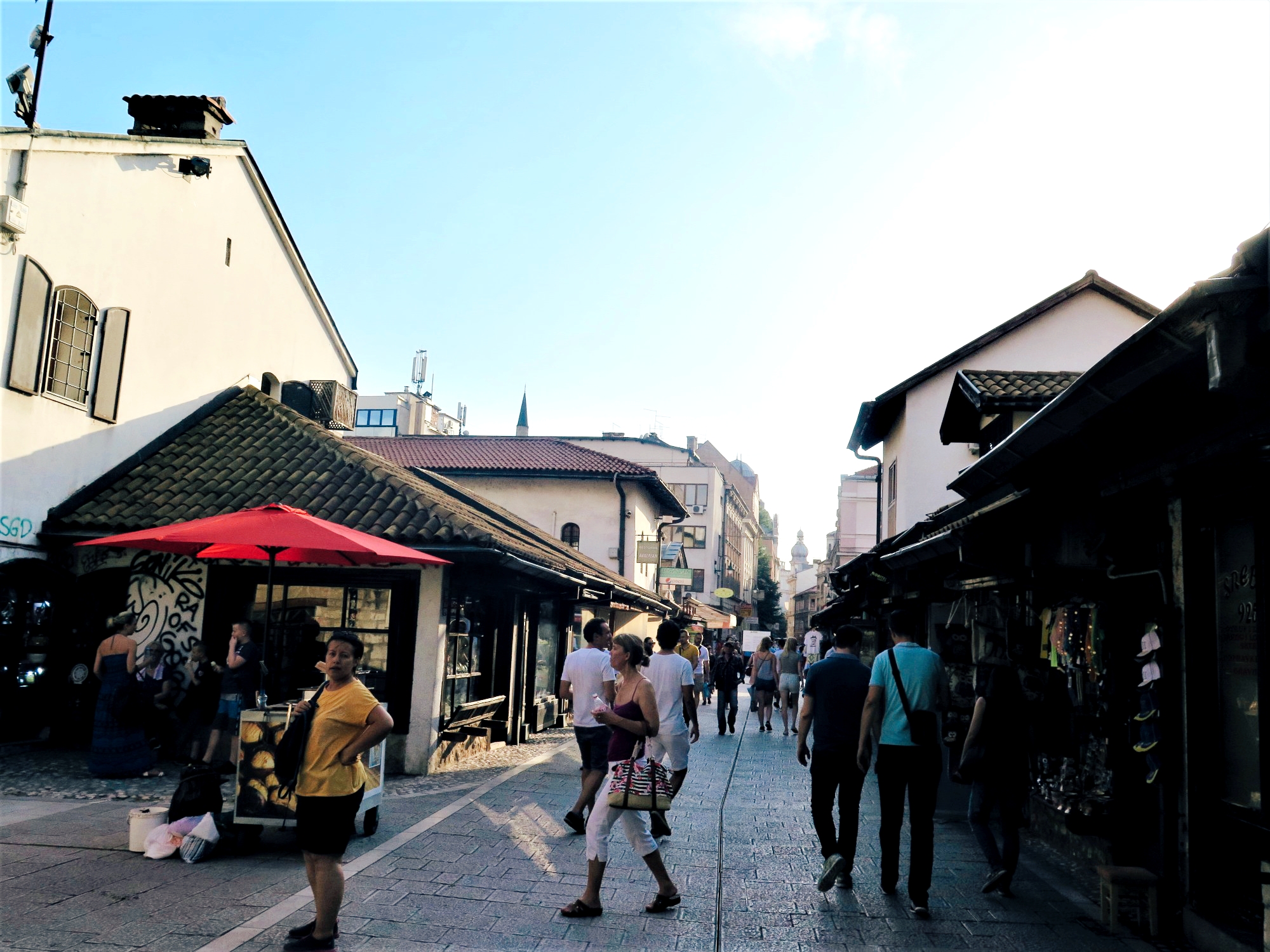

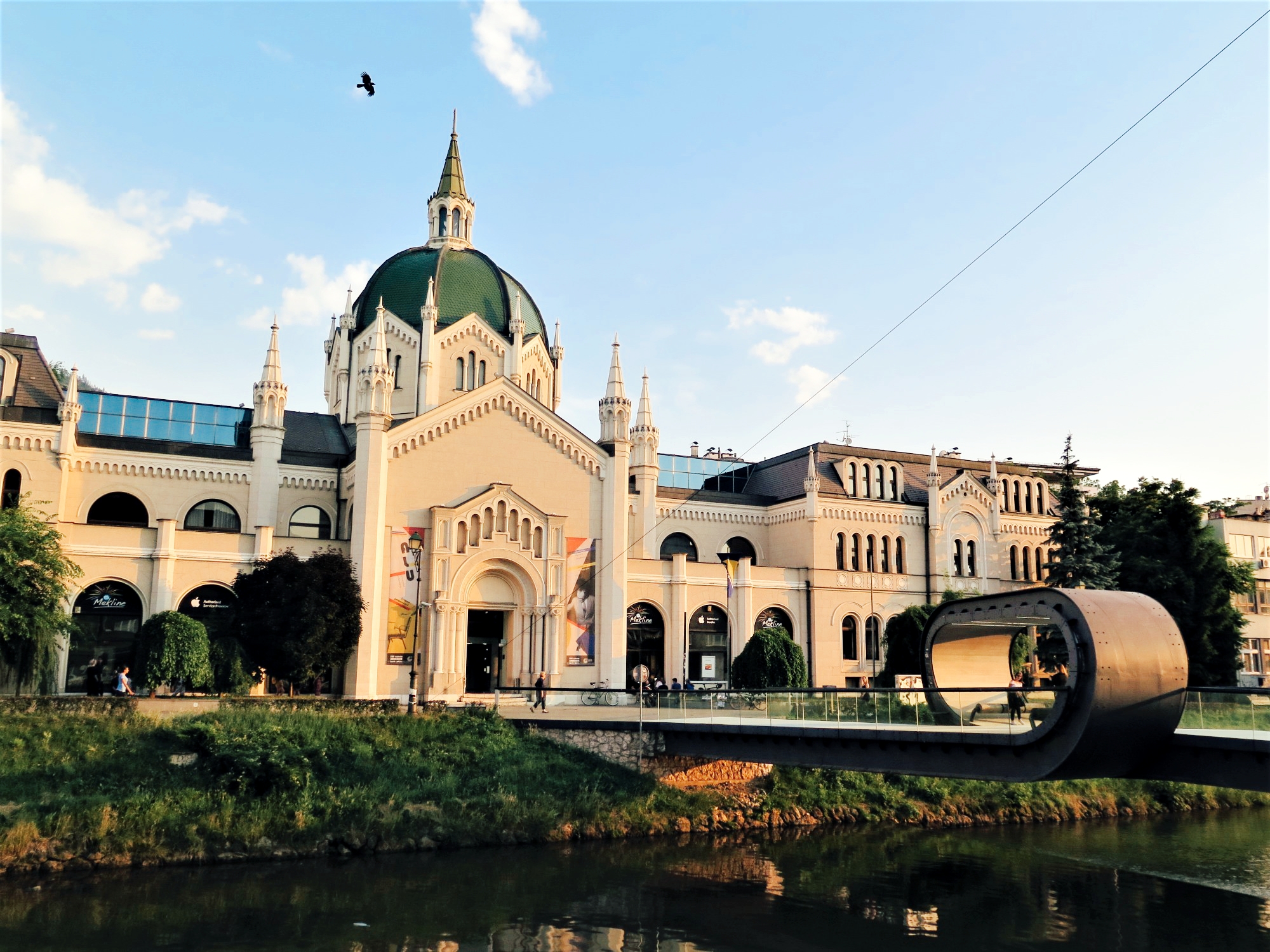
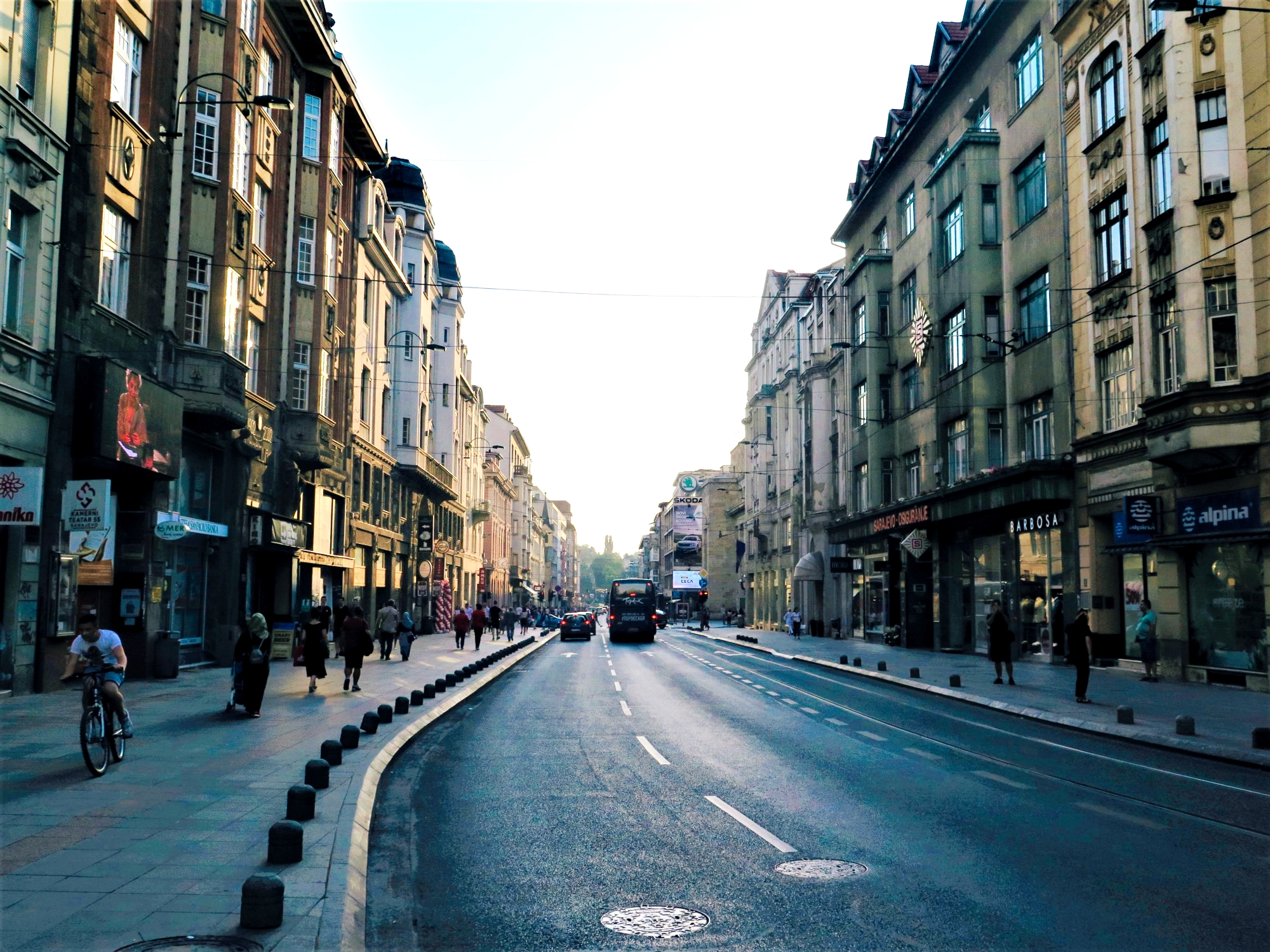

There, a place of countless marvels was waiting for us. As I already said before, Sarajevo is incredible. Made up from many little stories and legends incorporated to the walls of the historical buildings, and from all the locals who breathe in the rhythm of Sarajevo’s eternal vibes. You feel at home the first moment your eyes see all these elements combined. The European part of the city, though, is a bit less fairytalish (or a bit more realistic, on that matter). Regarding that, I count on my perception to have been influenced by my European background, which made me see the architecture I was more or less used to, when I was walking through the European part of Sarajevo.

Sarajevo Roses
& the story from the Siege of Sarajevo
The Sacred Heart Cathedral, which dominates the European part of Baščaršija, stands at its place since 1884. It was modeled by the man who finished the construction of Notre Dame in Dijon. However, the building has been damaged by the mortar shell explosion during the Siege of Sarajevo, which took place in the last decade of 20th century. In memory of this tragic event, you can still find a piece of art called Sarajevo Rose in front of the cathedral. These so-called roses are red symbols painted on concrete all around the city, commemorating both locals and visitors about the importance of peace and its contribution to the welfare of the society.
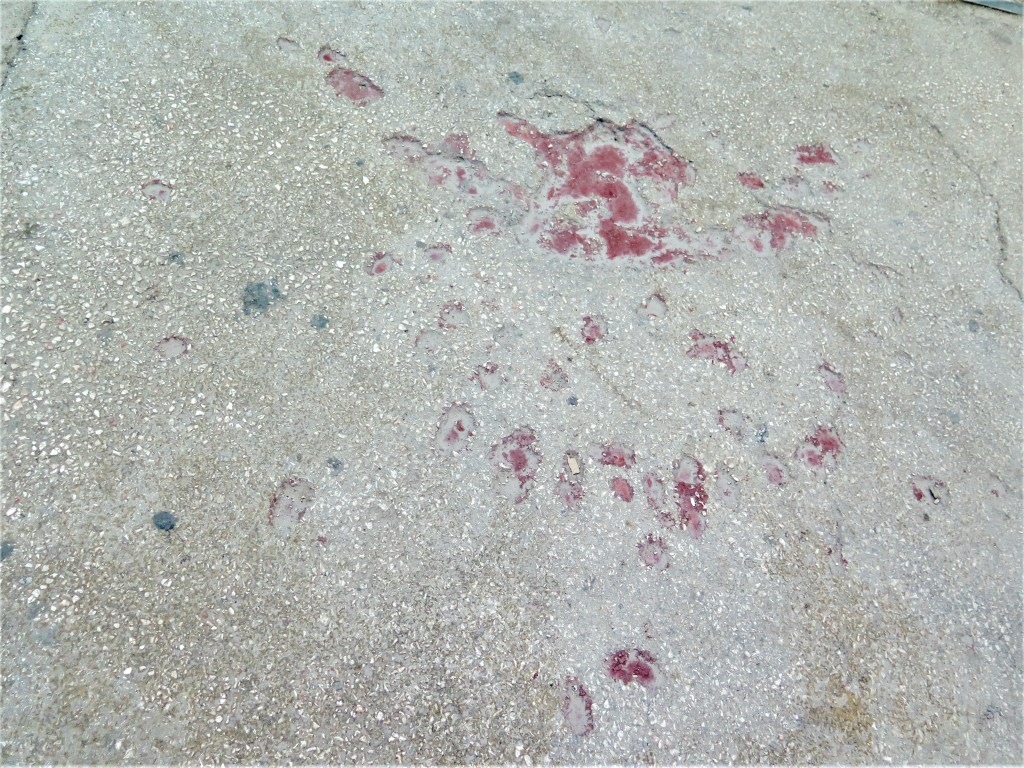
Indeed, Sarajevo has gone through many bad things in the past, and probably this factor also increases the value of peace in lives of its inhabitants. Thus, when we were walking around, we could enjoy the lovely athmosphere and friendly buzz floating from all directions, as so many people were outside to just enjoy the simplicity of summertime.
We walked towards the river to enjoy the view of mountains surrounding the city. In the mountains, there’s a few bastions which are very important to mention. Especially, Žuta tabija (Yellow Bastion) and Bijela tabija (White Bastion) which is considered to be no less than the national monument of Bosnia. This fortress is still open for visitors, but due to extensive damage during the Bosnian war, the restoration plan for this building is a necessity. We, ourselves, did not go up the hill to Bijela Tabija during our stay in Sarajevo, but we did enjoy the view of it from down below – walking by the riverside of Neretva and passing by the building of National Theatre, various galleries and last but not least, the legendary place of the Sarajevo assasination.
The riverside
& the story of Sarajevo assasination
I’m sure I don’t have to run into too much detail in terms of this historical event, because I’m sure all of you know it as its impact on the world was enormous at that time. So even we (especially guys, who were most thrilled to see the place of assasination of Franz Ferdinand d’Este) stopped by and took a couple of pictures. The place where the destiny of our world was so crucially influenced – and my three companions, still feeling the sadness of this tragic event…
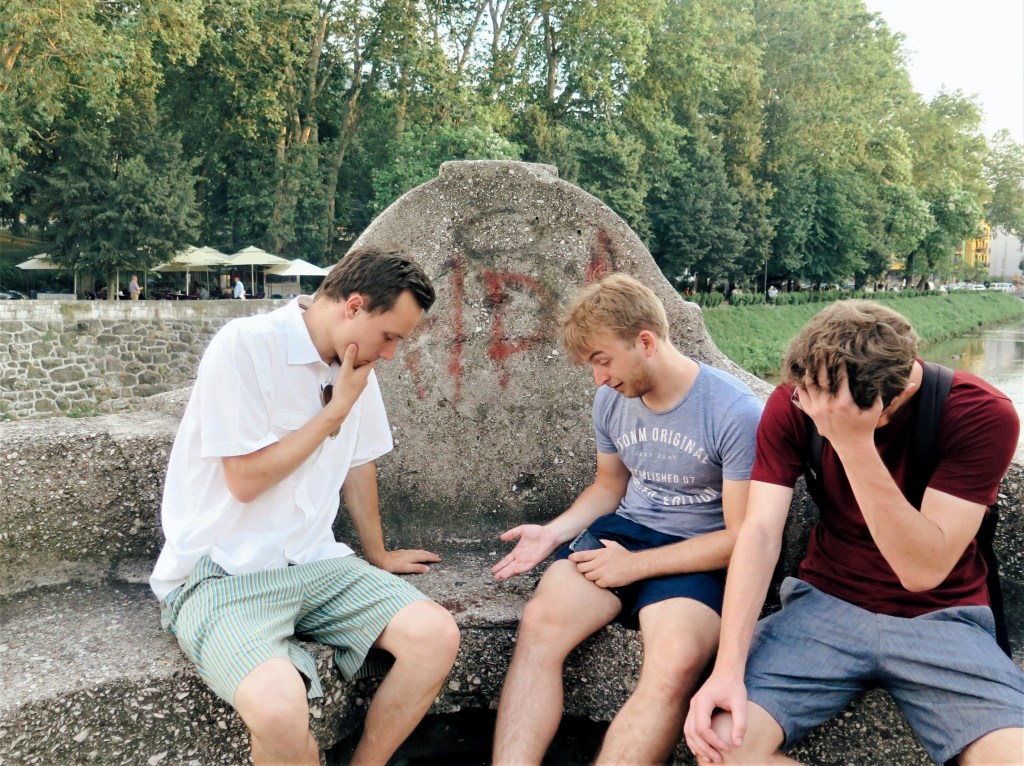

Down by the riverside, we wandered all the way to the Town Hall, which is not only interesting because of its shiny orange colour, but also by the fact that its area is also the station of Sarajevo’s cable car. This cable car takes you all the way up to Mt. Trebević where there’s the remains of Sarajevo bobsled track built for the Winter Olympics in 1984. Moreover, the cable car offers a great view of the city from the sky, which makes it a good choice for trips with kids, for whom such a ride will mean a package of unforgettable memories. Unfortunately, the cable car is much more expensive for tourists than for the locals (one ride costs foreigners 20KM – convergent marks, Bosnian national currency – whereas locals pay only 6KM per ride). Thus, we decided not to reach for the more expensive option of visiting Mt. Trebević and so we postponed planned visit of legendary bobsled track till next day.
Food street
& the story of the most amazing Bosnian dish

We walked back to the more Oriental part of the city, already psyched about experiencing a traditional dinner in Bosnian style. Personally, this was the most intense experience for me, as the restaurants in Baščaršija are very different from those we know and experience on daily basis in central Europe. First of all, waiting for other customers to make space for you is not rude at all in Sarajevo – it is part of their habits. Secondly, restaurants share tables outside, which means that you can go have dinner at one restaurant but end up seated in the sitting area of a completely different restaurant.
Funny enough? We’re just getting started.
According to Senida’s instructions, we found the restaurant street which is right next to the big square with Sebilj. The street was so crowded, it was as if the entire crowd of people that we had met at the square surrounding Sebilj decided to have dinner at the same place and at the same time. The concentration of people seemed even higher thanks to how narrow the street was. Around the long queue of restaurants, there were many little tables with people engaged to a lively chit-chat. We passed the entire street to see if there is at least one free table for us to sit. There wasn’t. But let’s not panic here – we thought and within 5 minutes we have been approached by a nice man who tapped my friend on a shoulder and led us to a table that belonged to completely different restaurant. After we made an order, he nodded his head and went back to the restaurant he was working for. But here’s the thing – while we were waiting for food from his restaurant, a waiter from this completely different restaurant approached us, too. We didn’t even try to explain that we were customers of another restaurant because we knew it would be rude. But later on, we realized that that’s the way of how they have it agreed between the owners of particular restaurants.
You get approached by one waiter, you get seated somewhere else, offered food from one restaurant and drinks from another one. That’s also why guys ended up with white yoghurt served as beverage from the first restaurant and a pint of pale ale served from another one. But they all managed – or to be more precise, their stomachs did. And the food – aww, delicious! Served on a huge silver plate, you get an enormous portion of čevapi placed into a salty pita with any dressing you want. In the end, you’re so content to have dinned so well, that you don’t even mind paying two bills. And why would it matter? After all, when in Bosnia, do as Bosnians do.

When leaving the restaurant, we thanked the waiter for a good meal and he again smiled and tapped the shoulder of my friend. He then felt so flattered that he even started thinking about being the most friendly of our whole troop. Indeed, I must admit that Sarajevo suited him well. But Sarajevo suited really well to all of us, since we were a mixture of passionate travellers, explorers and daydreamy artists who searched for something more than just the visible atributes of Bosnian metropole. We searched for the soul which soaked into the architectonic jewels the city was made of, the colours of the sunset implemented to the city aura. The breath of the city was so sensible, so that from the first moment it got into our veins and we felt as if we belonged there. As if the city was accepting us and welcoming us, soothing us with its cheerfulness and serenity. That’s why Sarajevo suited us all so well.
Sarajevo night life
& the story of the most exciting workout ever
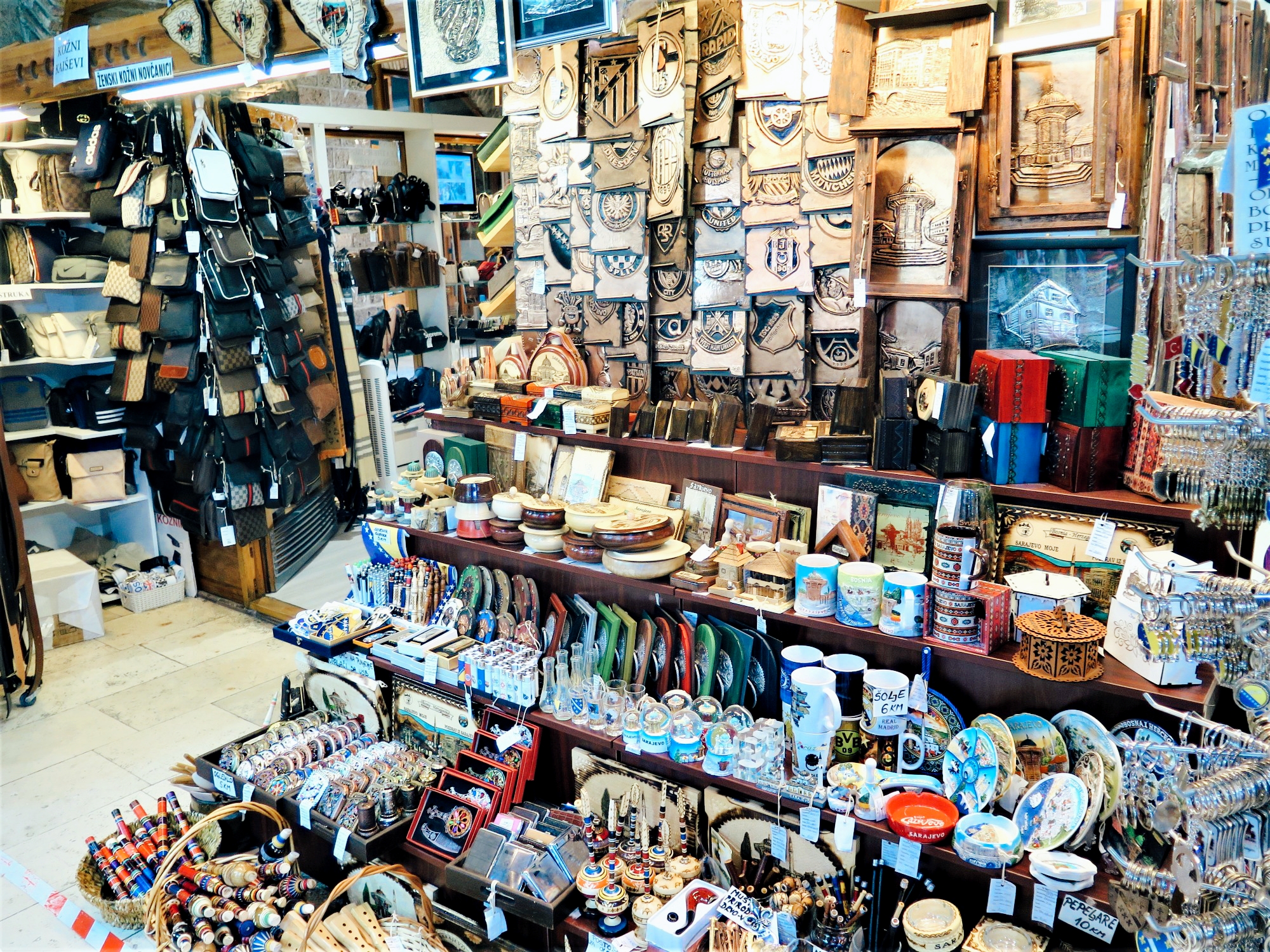
And when the sun went behind the horizon and the city lights went on, that was the very moment that made me want to fall in love. For me, it was never hard to fall in love, no matter if it was with a person, a book, a song or a city. Though whenever falling in love, the first thing I always feel is an overwhelming amount of energy. It was no different in Sarajevo – as if the city itself was a huge battery, recharging every visitor’s tired soul. I remember all the problems and struggles went away at the time when I was in Sarajevo. I was so completely mesmerized by the city, lost in the labyrinth of little shops and cafés. I even bought myself a notebook in the market which I swear is handmade, with brown pages and wooden cover knotted together by a piece of twine. To this day, I carry it with myself wherever I go and I inside of it, I write down every single trace of an idea or inspiration I get (and which is worthy writing down, of course).
Mentioning the little shops and cafés of Baščaršija, I tasted baklava for the first time in one of Sarajevo’s patisseries. I remember it was at 10pm, which is under normal conditions too late for me to eat anything sweet. But this was no ordinary day – it was the day I fell in love with Sarajevo, so I eased my healthy dietary habits and gave in to the bohemian lifestyle for a while. Or to be precise, only for 30 minutes which we spent there…
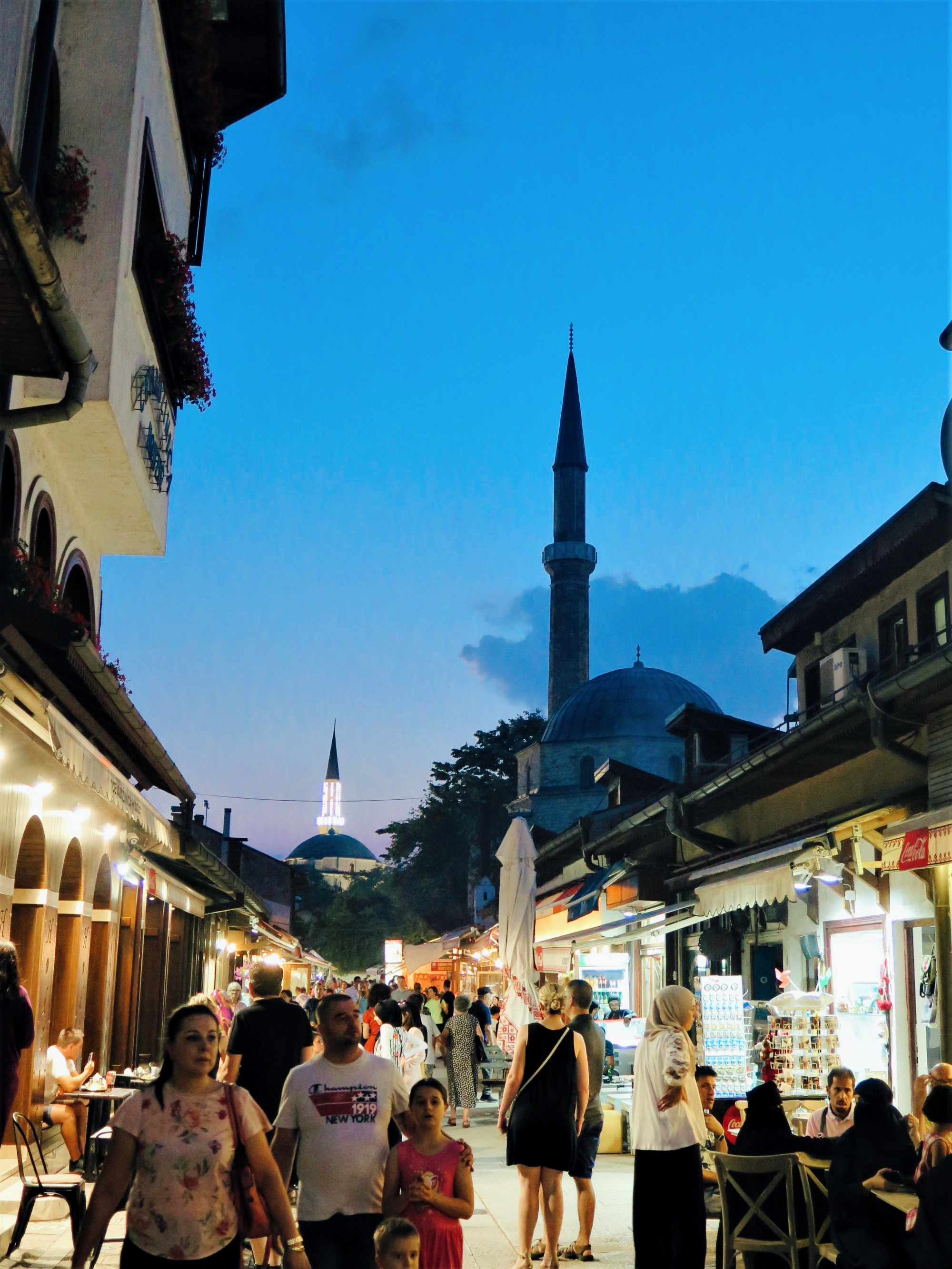

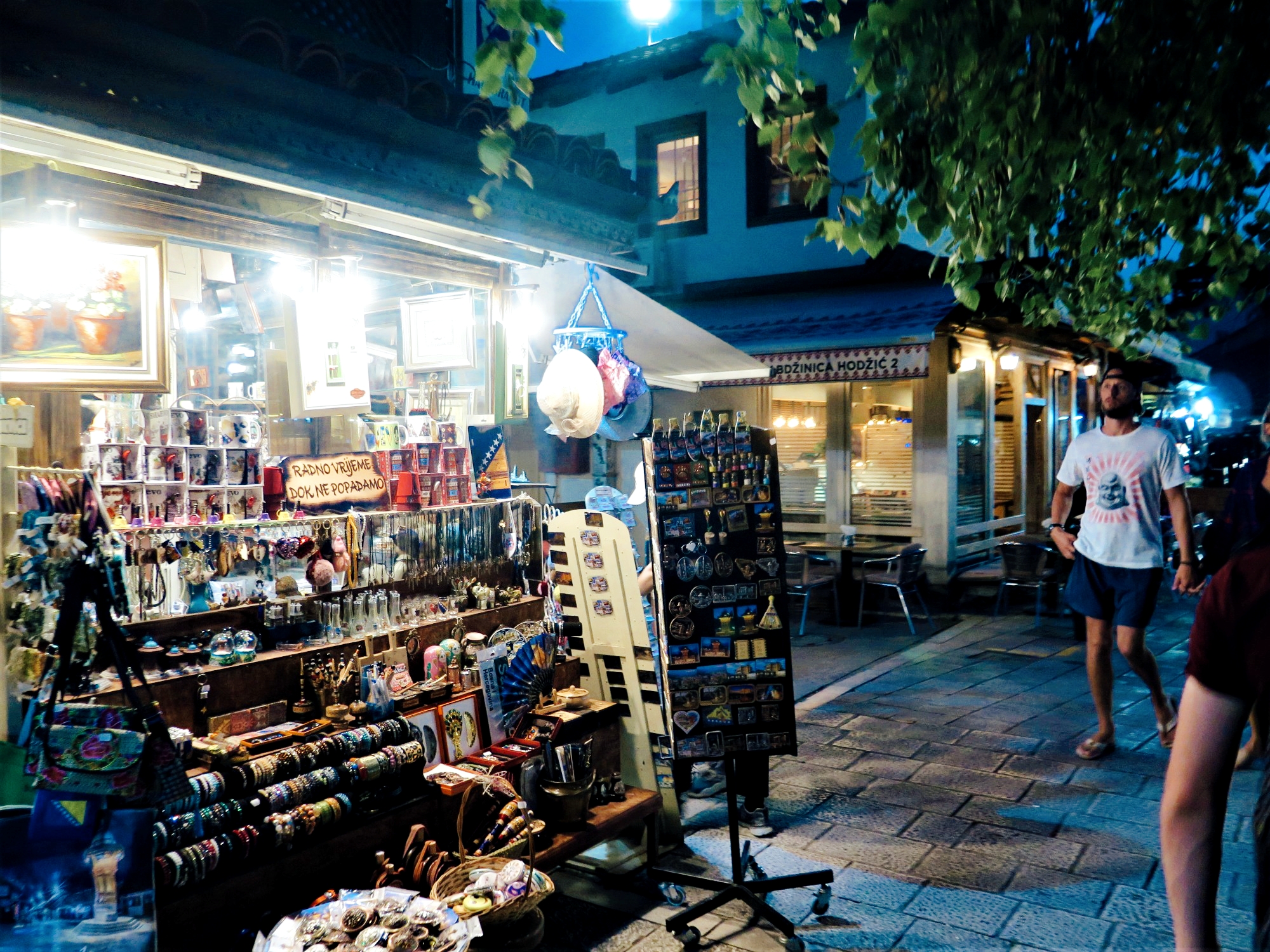


After that, we decided to leave the city centre and go to sleep. But in our way, there was almost an hour-long walk up the steepest streets I’ve ever experienced. I remember we were still not sure whether to take a cab or not when we were leaving the square with Sebilj, but in the end, we decided (or guys decided) that we were determined enough to make our way back to our accomodation. For the record, I was the least determined of all of us but I regretted eating baklava so late at night and therefore, I agreed to the plan.
In the end (and after several mental breakdowns), I even managed to get up the hill as the first one of us. I might seem like bragging, but that was my first and last race I won during our trip to Balkan Peninsula, so I have to state it here.
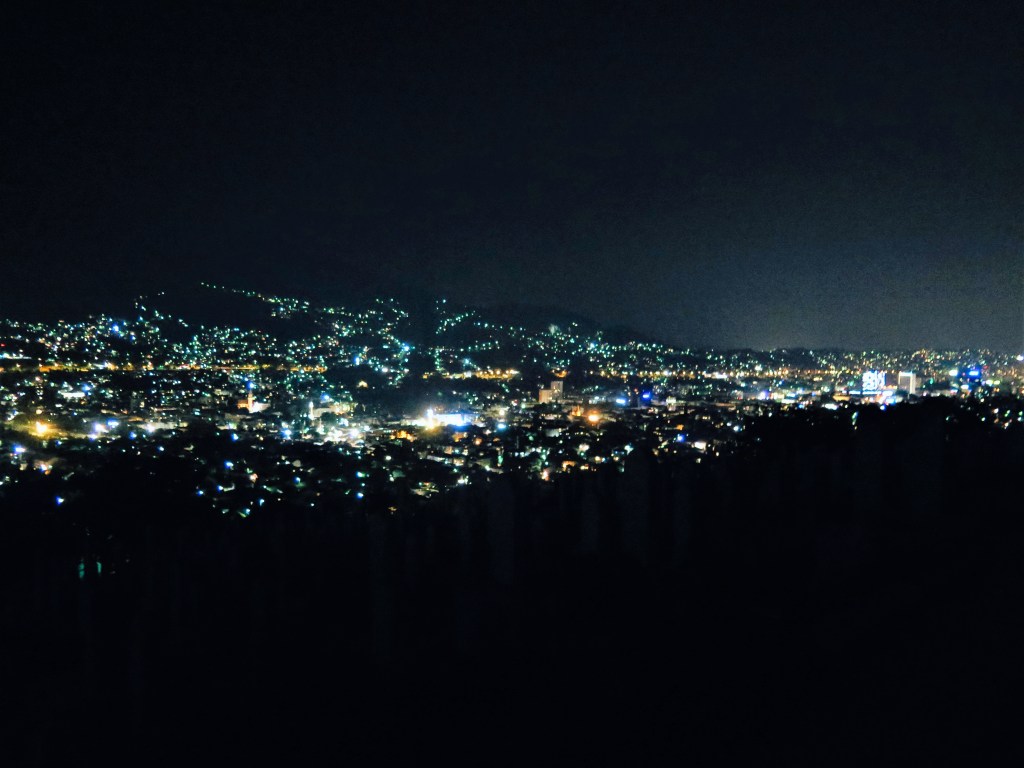
That was the end of our first day in this charming capital city – a day I’ll never forget. Falling asleep, I felt the urge to compose songs, to write a novel and to start writing this blog as soon as possible, noticing the overwhelming amount of inspiration arising from the depths of my heart. I felt as if in Sarajevo, I discovered a place which felt completely different from all the other places that I had ever seen before. That’s how with my eyes slowly closing, Sarajevo has become my something special. My endless love among the European cities. And that was not even the end of our Bosnian adventure, just a bare beginning.
Dawn in Sarajevo
& the story of a beautiful morning prayer
I woke up at 4am the next day, as the sun was rising and our beautiful city was waking up to another hot summer day. However, the thing that broke my string of dreams wasn’t my hunger, nor the need to pee. It was a song – or a morning prayer that was echoing through the streets and awaking most of Sarajevo’s inhabitants. Along with the voice coming from a nearby mosque, all the cats hidden in the streets were joining this sunrise prayer by mewing really loud. All these sounds were arriving to our bedroom, through an open window and white curtains swaying in a cool morning breeze. I remember opening my sleepy eyes, the first moment of waking up I didn’t yet realize where I was. But I very soon realized where I was, and a light smile brightened up my face. Enjoying this completely new experience of sunrise prayer, I was soaking another bit of Sarajevo’s character into my veins. And when the city became silent once again, I closed my eyes and went back to sleep.
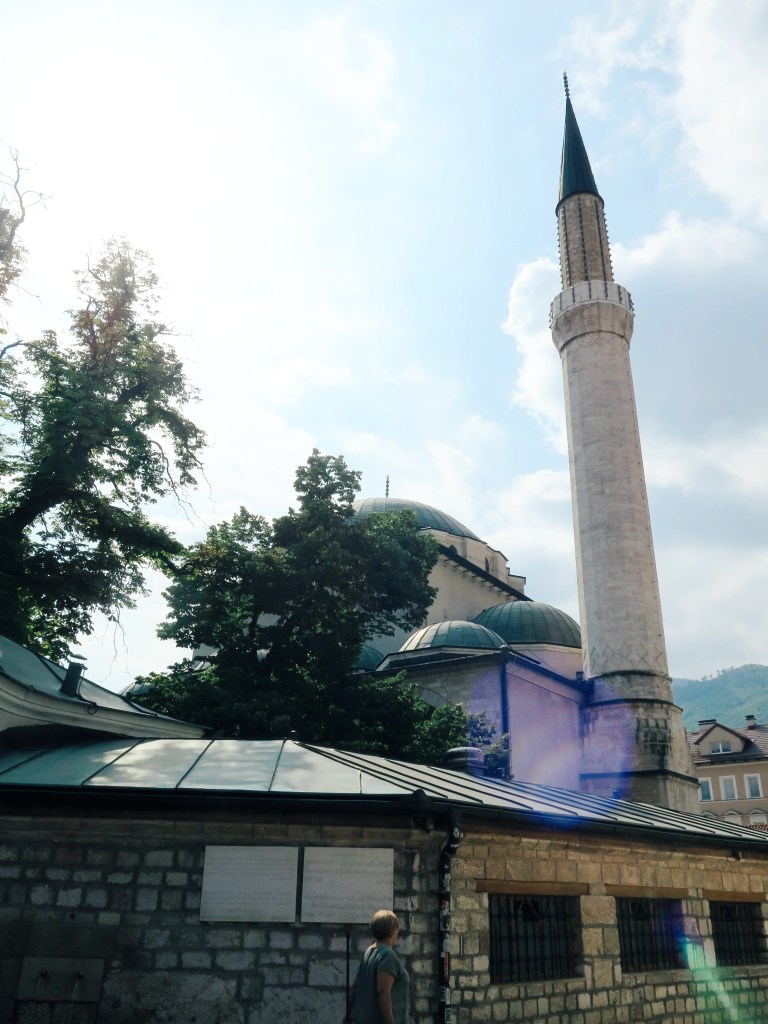
Mornings in Sarajevo were beautiful. Like the one when we decided to visit the Sacred Heart Cathedral and Gazi Husref Beg’s mosque and so in 30 degrees Celsius, we dressed up to long-sleeve T-shirts and long trousers so that we wouldn’t be disrespecting the local manners. Speaking of Gazi Husref Beg’s mosque (or Begova mosque), a lovely story pops into my head. It is a story of a noble man, Husref Beg, and all his endowments which he left as a trace of his generosity all around Baščaršija.
Gazi Husref Beg
& the legend of the biggest mosque in Sarajevo
Husref Beg is to this day known as one of the biggest benefactors of Sarajevo, as he is believed to have left his entire wealth for building and maintenance of the places in the old city which he decided for investing into. Legends of old Sarajevo also state that at an old age, Husref Beg gave all his property to charity. Thus, in minds of the locals he’ll forever be remembered as a great philantrop. But let’s go back to the story of his mosque.
People say that its creation was based on an order of Turkish Sultan. He sent a message to Husref Beg, where there was stated: „Build two mosques in Sarajevo, one for me and one for yourself.“ And so Husref Beg obeyed Sultan’s order. Before the start of the works on the future symbol of Bosnian capital, he called a potential builder to make a contract with him. Though before leaving the works on the mosque to him, he firstly asked a simple question.
„Tell me,“ he said, „what should one do first when building a mosque?“
The builder replied: „Well, build it.“
This answer did not please Husref Beg and so he ordered man’s execution. After that, he called the second builder and asked him the same question.
The second builder thought for a while and then went up front with his answer: „First, you build the kitchen so that the workers will be able to obtain food.“
But not even this answer pleased the great benefactor, and so another execution order was made. After that, Husref Beg called third builder and again, asked the very question.
The third builder took his time with answering but his answer made Husref Beg very content: „At first, you should build a lavatory so that the workers would not foul the area of future mosque.“
After hearing this, the third builder was approved for building the most renowned mosque in Sarajevo. And when his work was finished, Sarajevo had two brand new beautiful architectural landmarks and sacred places for everyday prayers.

Husref Beg sent a message to Istanbul, to inform Sultan about his order to have been fulfilled. But Sultan sensed some potential trickery from his Bosnian friend, since at the time of receiving Husref Beg’s message he already knew that one of the two newly built mosques is bigger and more beautiful than the other. So as an answer to Husref Beg’s message, he sent another order: „Let the mosque that you have built for me be yours, and let the one that you have built for yourself be mine.“
But by sending out this order, he fooled himself as the bigger and more beautiful of the mosques was meant to be Sultan’s mosque. And so, today we can admire Gazi Husref Beg’s mosque which is larger and more richly decorated than the Sultan’s mosque. But we must not leave Sultan’s mosque completely aside, either. According to another story, even this mosque has something special. According to Legends of old Sarajevo, the Sultan’s mosque has the staircase of its minaret comprising 118 steps, whereas Husref Beg’s has only 115. But as you sure know, minaret is not a place where tourists could be allowed to go, and so we could not reassure ourselves about the historical accuracy of this story by counting steps in both mosques.
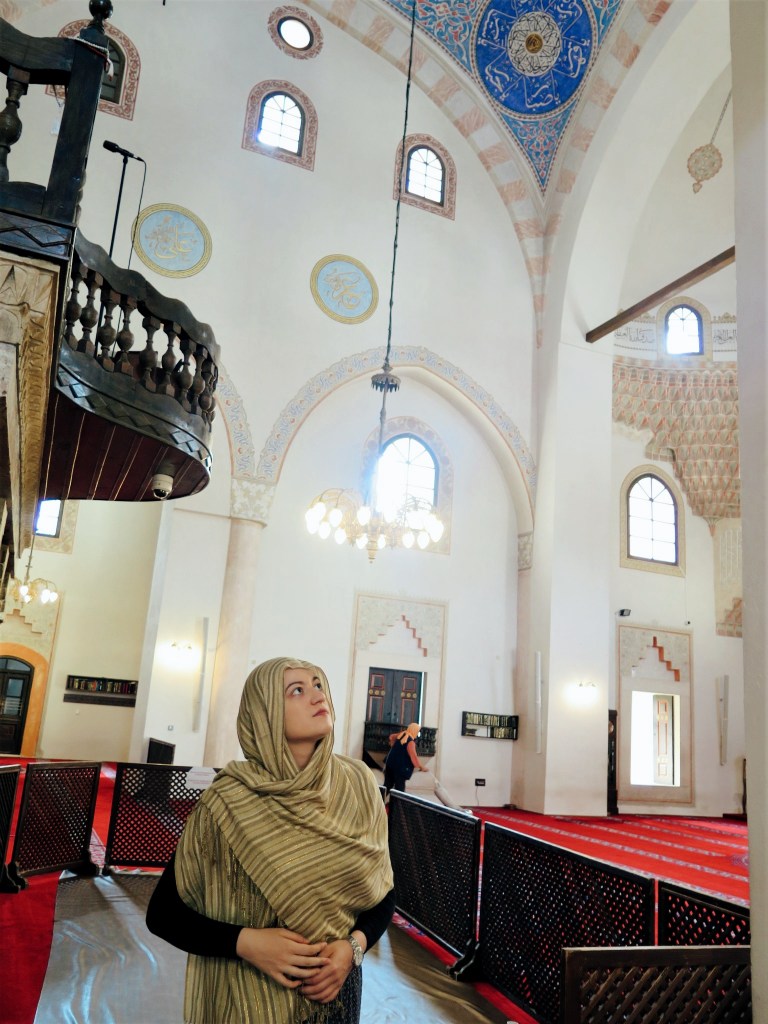
Instead of that, we walked inside Gazi Husref Beg’s mosque for a while. It’s obvious that once you’re there as a visitor, you should pay hommage to muslim traditions which I was really happy to do during my visit. So to women I advise bringing something to cover their hair with (a bigger scarf is perfectly enough).
The athmosphere of the interior of Gazi Husref Beg’s mosque is very special, that’s something that can’t be denied. I myself experienced a brand new feeling when I came inside – it was some mixture of delight, respect and admiration of this unique building. So I can recommend, the experience is truly worth it.
I must apologize for my blog about Sarajevo is severely lacking the historical stories and legends of the city, but our visit of Bosnian metropole made me so very absorbed in our own stories, so that sharing our stories with the city became my biggest concern when writing this part.
Another story I have to share was our extraordinary breakfast in the middle of Sarajevo old market. After visiting the mosque, we had to wait another 20 minutes for the restaurants and shops to open (since we were earlybirds again and the restaurants in Sarajevo open at 10am). But it was worth waiting for, as shortly after 10am we were already sitting behind a long table outside, facing the surprisingly empty market street with a warm börek on plates right in front of us. Very extraordinary, you must think now and I agree. Börek is not a dish served for breakfast, but at that time I didn’t care. I just enjoyed it. And to be honest, the portion was again so large, that one of my friends had to finish it instead of me. At that time I didn’t yet know that this breakfast would also be my lunch, but nevermind…

Mt. Trebević
& the story of the Olympic bobsled track
A far bigger adventure was still ahead of us. And this adventure was the visit of old bobsled track constructed before Winter Olympics, 1984. According to the words of our host, Senida, this huge sports event was supposed to save Sarajevo’s reputation after long years of wars and socioeconomical uncertainty the city and whole country had been facing. It was a rope that was meant to drag this city back up to the spotlight. And it’s purpose has been successfully achieved – if only the history of Sarajevo didn’t continue with another armed conflict, that brought the fortune and economy of the city back low.
During the conflict, the bobsled track suffered from a damage and that’s why it is now in such a bad state. It is now a ruin, standing proudly in a forest (a few kilometres away from the Olympic village that burnt in a fire during Siege of Sarajevo) with branches of trees growing really close to the concrete scaffold. We went down this track that day, just to see where the journey leads us and also to assess how big part of the bobsled track still remains usable (theoretically). And that’s when a very surprising thing happened to us. During our walk, we encountered a sign saying: „Attention! Do not enter the track! Training is in progress.“
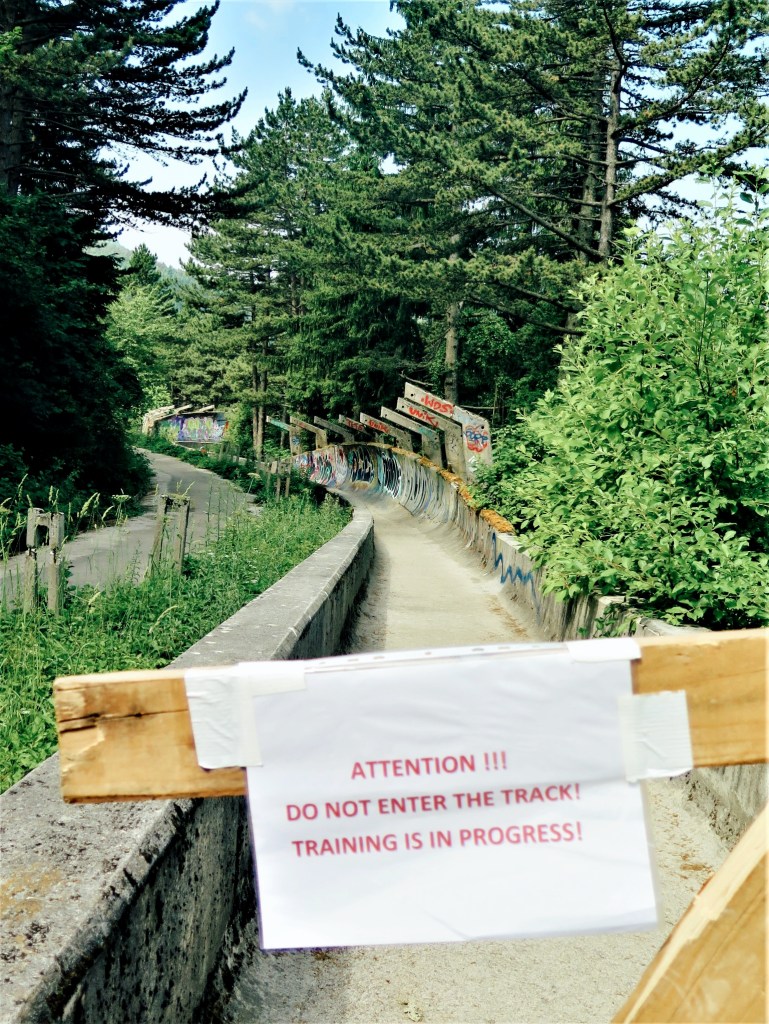
At first, we considered it an old sign, but something was pretty suspicious about it. It wasn’t torn apart, the letters were not blurred from the rain or wind. All these aspects were leading us to only one conclusion, which was that the sign was new. Passing a few metres we started hearing voices. We stepped away from the track and returned back to the pathway that was made very close to it.
After a few steps, we saw a guy dressed in purple jersey. He sat in the bobsled track, putting his protective helmet on. Then some shout was audible from another part of the track. After hearing the shout, the guy moved with his hands and started sliding down the track, acquiring impressively high speed. I was really happy to see that the track still finds purpose, even after the upper parts of it being severely damaged. But the biggest surprise for me wasn’t even the fact that track was being used. The thing that surprised me even more was who was actually using the track for training young bobsledders.
As we were really far from the big group of people who were apparently taking turns in trying out sliding the track, all the shouts I heard from the coaches were a bit indistinguished – the words were always just melting to huge soundwaves. But as we were approaching the group at the lower part of the track, I started recognizing the speech of the people shouting orders to the guys on the track. And you guess why I recognized the words so well. It was because the language they were using was my mothertongue.
When I recognized it, I looked over at the sign on one of their cars. The sign was carrying the letters characteristic for Poprad, a city near High Tatras and very close to my hometown. So that’s how in the far far south, I met my compatriots, and also reassured myself about the long known truth that Slovakians are everywhere. In every single country, every single city and every single pub with good beer.
Moreover, that day we not only could watch actual bobsledders doing their thing on the bobsled track, but also we could see how it must have looked like in the times when there were many people around the olympic track, watching the best sportsmen in the world fight for the title of olympic winner. And last but not least, we realized it is no fun walking down the bobsled track with risk of being hit by an actual bobsledder. The speed they go down at is incredible – I mean, you can’t even catch them by a camera, because of how fast they slide.

Mt. Trebević with historical bobsled track not only offers the memory of a legendary sports event, but it also provides you by nice nature, many steep pathways, high trees throwing shade on you during days of unbearable heat and of course, many many views of the city laying at the tip of your nose. Just look at it – look at the beauty…
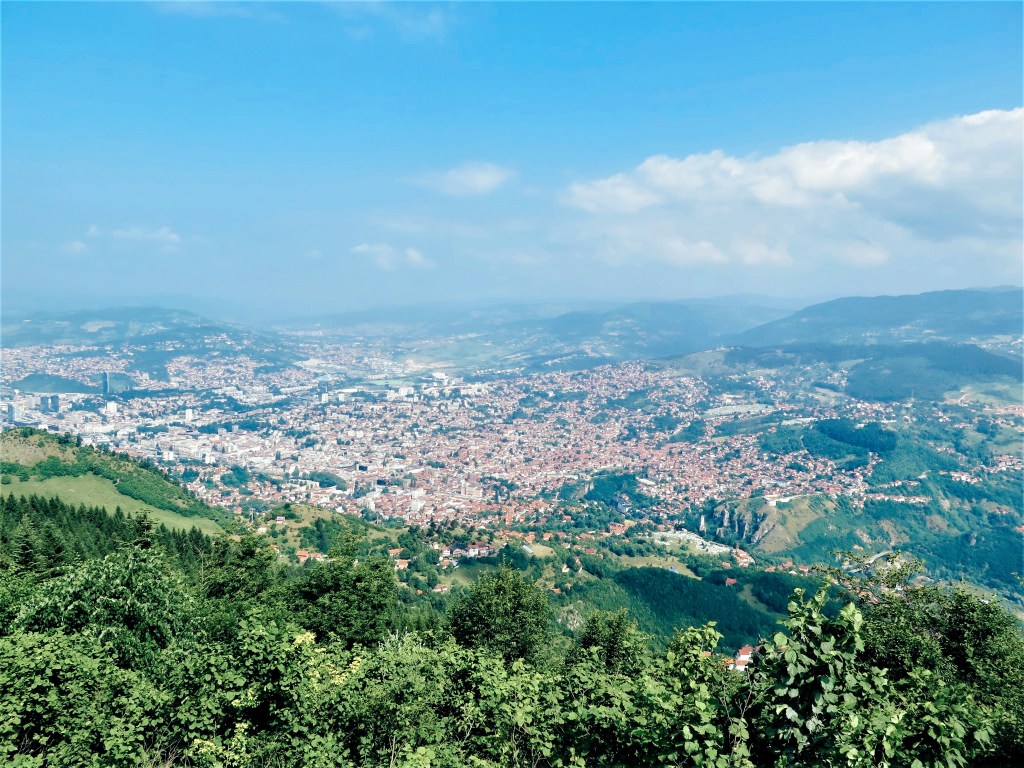
What a good point where to end my short talk about this jewel of Bosnia. I guess if I have not yet made you tempted to go there, then I can still add one thought of mine, just to gently sum up our visit of Sarajevo.
Epilogue
How do I recognize a city which really steals my heart? Well, simply by the intense need of creating something new, this huge outburst of inspiration which at one point breaks free and starts making my mind put words into rhymes and sentences into lovely little paragraphs. Sarajevo was the city whose charisma made me start writing this blog one day after we left. I was not even prepared for writing so intensely, as we were still travelling at that time and sightseeing everyday from dawn to dusk.
But Sarajevo didn’t leave me be days after we left. It didn’t leave me be even weeks after we left, not even months after our visit. Not even now, when I’m engaged to completely different travel in a completely different country, I still carry piece of Sarajevo in my heart. And this little piece of Sarajevo still holds a great deal of inspiration within my soul, for whenever I close my eyes and imagine being lost in stone maze of Baščaršija, new lyrics pop into my head. I guess this city consists of so much artwork so that it makes Sarajevo itself one huge artwork. And I, desperate artist, cannot wait to walk its streets once again and let the endless flow of inspiration refill my soul with new rhymes and ideas. Till then – stay safe, Sarajevo!
Love,
Antonia
Have you enjoyed reading the Love Letters?
Follow us for new content delivered right to your inbox.
 Love Letters to the World